- Use a phone agent for urgent, emotional or multi-step issues and for callers who will not type. Use chat for simple, low-stakes questions that benefit from text.
- Text self-service costs less per contact, but a 2026 Gartner survey found only 27% would try a chatbot again after a bad experience. Always give a route to a person.
- Do not pick one. Run both against one customer record in your own systems so a chat can become a call without the customer starting over.
Which is better, an AI voice agent or a chatbot?
Neither wins in general. Use a voice agent when the issue is urgent, emotional or has several steps, or when the customer will not type. Use a chatbot when the question is simple, low-stakes and easier to read than to hear. Most businesses need both, on one customer record, with a person behind each.
Disclosure: VoiceGenie publishes this post, and we sell a phone agent, not a chatbot. That bias is real, so the post spends time on where chat is the better tool. For how a phone agent works, read what an AI voice agent is.
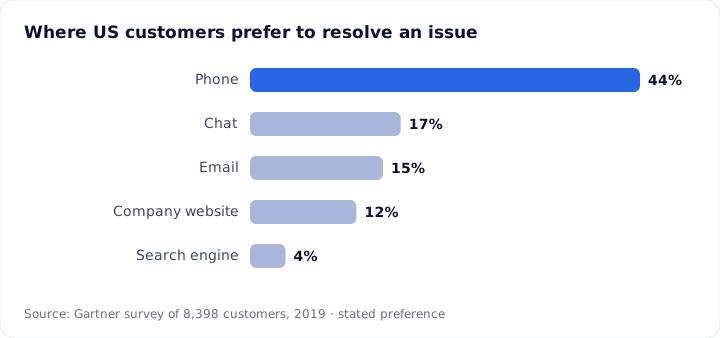
Customers say they still want the phone. In a Gartner survey of 8,398 customers, 44% preferred the phone to resolve an issue and 17% preferred chat [1]. That survey is from 2019, before today's AI tools, so it shows a starting point, not a verdict.
What the two channels are good at
A chatbot works in text. It is quiet, asynchronous, easy to scan, and leaves a written record the customer can reread. A customer can start it on a train, on a work laptop, or at 2 a.m. without waking anyone. It handles links, order numbers, forms and short answers well.
A voice agent works in speech on a phone call. It answers right away, carries a worried or rushed customer through several steps, hears tone, and reaches people who do not use apps. It can also place calls, which chat cannot do unless the customer is already online.
Neither is a magic fix. Both fail the same way: they stall on a hard problem and trap the customer. The CFPB found chatbots become less effective as problems get complicated, and described customers stuck in "doom loops" with no way to reach a person [3]. A voice agent that cannot reach a person fails the same customer, only out loud.
Decision table: which channel for which situation
Choose by what the customer is going through, not by what the technology can do.
| Situation | Better channel | Why |
|---|---|---|
| Quick fact: hours, order status, a tracking link | Chat | Text is fast to scan, and a link is easier to tap than to hear |
| Customer is anxious or upset: a missed delivery, a card block | Phone | Tone and pace matter, and the customer wants to hear an answer now |
| Urgent, time-sensitive issue | Phone | No waiting for a reply in a text thread |
| Several steps with back and forth: rebooking, changing an order | Phone, or chat with a call offered | Speech is quicker for dialog; chat suits it only if the steps are short |
| Customer is driving, working with their hands, or has low vision | Phone | They cannot type |
| Customer is at a desk and wants a written trail | Chat | Easy to keep and quote |
| Customer should receive an outbound reminder or follow-up | Phone, with an SMS link | Calls reach people who are not on your site |
| Sensitive data, such as a card number | Neither by voice or free text | Send a secure link to the phone on file |
| Disputes, hardship, legal or safety issues | A person | Judgment; the AI collects facts and hands off |
Age and context help, but only a little. Pew found 78% of US adults 65 and older own a smartphone, while 14% are online almost constantly, against 63% of those 18 to 29 [4]. That says older customers are reachable, not that they prefer calls. Pew does not report channel choice. Offer both and let the customer pick.
Cost per contact: what the numbers say, and what they do not
Text self-service looks cheaper per contact. Gartner's 2019 poll of service leaders put live channels (phone, live chat and email together) at about $8.01 per contact and self-service such as websites and apps at about $0.10 [1]. That is old, and it blends channels, so it cannot tell you the cost of a voice agent against a chatbot. I found no primary source that compares those two directly.
Here is a worked example you can rebuild with your own numbers. US customer service representatives had median pay of $21.53 per hour in May 2025 [5]. Across US private industry, total employer cost per hour was $46.89 against wages of $32.82 in June 2026 [6]. That ratio, 1.43, puts a loaded hour near $30.76, or about $0.51 a minute, before software, supervision, idle time and training. This is my estimate, not a published benchmark.
On an assumed 6-minute phone call, a person costs about $3.08 in wages alone. The same 6 minutes on a VoiceGenie AI agent is 6 minutes at $0.14 per minute, billed per second. You bring your own carrier, so line charges depend on your provider. The six minutes is an assumption.
Cheaper per contact is not cheaper per resolved issue. If a chatbot fails and the customer calls anyway, you pay twice. Gartner's 2026 survey of 3,566 customers found only 27% would try a chatbot again after a negative experience, and 87% said access to a human is essential when companies use generative AI [2]. Measure cost per issue resolved without a repeat contact. See how to measure the success of an AI voice bot.
Where chat is the better choice
Be fair to chat. It wins in more places than phone vendors like to admit:
- Silent settings. Open offices, trains and late nights are poor places for a phone call.
- Simple lookups with links. A tracking link or a policy page works better in text.
- Written records. Customers who want a trail they can quote prefer chat.
- Low-intent browsing. A visitor comparing plans on your site should not be pushed to a call.
- Cost-sensitive, high-volume FAQs. Text self-service is the lowest cost per contact in the Gartner poll [1].
It is also in wide use. The CFPB cited an industry estimate that more than 98 million users, about 37% of the US population, engaged with a bank's chatbot [3]. The lesson is not to avoid chat. It is to scope it to what it answers well, and to give it a door to a person.
How to run both on one record
Two channels fail when they do not share history. Keep the shared record in your own CRM or help desk. A customer who explains the problem in chat and then repeats it on the phone has had a bad day.
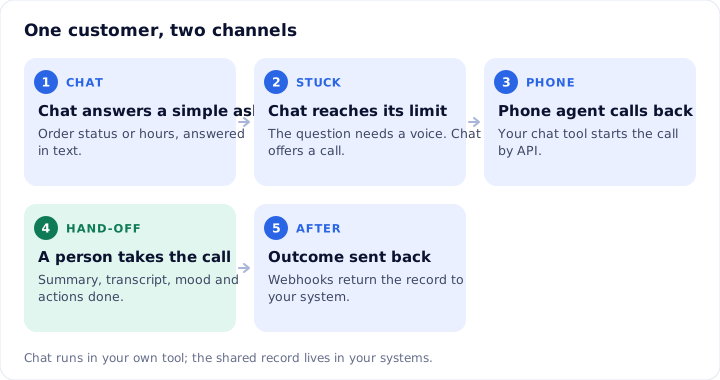
The plan, in the same five steps:
- Chat answers a simple ask. Order status or hours, in text.
- Chat reaches its limit. When the question needs a voice, chat offers a call instead of looping.
- The phone agent calls back. Your chat tool starts the call by API.
- A person takes the call when needed. On VoiceGenie the person sees a summary, the transcript, the caller's mood and what the AI already did.
- The outcome is sent back. Webhooks return the conversation record to your system, so both channels show the same history.
VoiceGenie covers the phone side: AI agents, a human desk and AI Assist on one record. Chat runs in your own chat tool, which can start a call by API. After every attempt, webhooks send the full conversation record and post-call analysis to your systems. Here is what the person sees at hand-off.

A short call you can copy
Here is a sample of a phone agent doing the job chat is weaker at: an anxious customer and a missed delivery.
Hello, this is Shop Easy. Your order is packed and ready to ship, and we have a delivery slot tomorrow between ten and twelve. Does that work for you, or would you prefer a different time?
In English: Hello, this is Shop Easy. Your order is packed and ready to ship, and we have a delivery slot tomorrow between ten and twelve. Does that work for you, or would you prefer a different time?
Listen for how fast it gets to the point and how it treats a worried customer, and check that a person is one request away. VoiceGenie does not announce itself as an AI by default; the announcement is a setting you switch on per agent, and I would switch it on. A recording notice is not a setting: you write it into the agent's opening line.
When VoiceGenie is the wrong choice
- You only need a website chatbot. We do not sell one. A chat vendor will fit better.
- Your customers never call. If your contact data shows almost no phone traffic, start with chat.
- You need a single tool for chat, voice, email and social. A full omnichannel suite may suit you better; ours centers on calls.
- You need to bring your own AI model. VoiceGenie does not support that.
Where it fits: AI agents priced per minute with no minimum, a human desk priced per seat, your own carrier and numbers, and set-up that is self-serve or done by our team. VoiceGenie's security program is built to the SOC 2 Type 2, ISO 27001 and ISO 42001 standards, and it handles personal data in line with GDPR. Security documentation is shared on request. See the pricing page, the customer support use case, and conversational voice AI vs IVR for the third option in this family.
Common questions
Is an AI voice agent better than a chatbot?
Neither is better in general. A voice agent suits urgent, emotional or multi-step issues and callers who prefer to talk. A chatbot suits simple questions, links, order status and customers who want text they can keep. Pick by the situation of the customer, and plan a hand-off to a person from both channels.
Which is cheaper, a chatbot or a voice agent?
Text self-service is cheaper per contact. Gartner's 2019 leader poll put self-service near $0.10 against about $8.01 for live channels, but that mixed phone, chat and email. No primary source I found compares AI voice and AI chat directly, so measure your own cost per resolved issue.
Do customers prefer phone or chat?
In a Gartner survey of 8,398 customers published in 2019, 44% preferred the phone to resolve an issue and 17% preferred chat. That is stated preference from before today's AI tools, so treat it as a signal and check your own customers by asking them or reading contact data.
Can I run a chatbot and a voice agent together?
Yes, and it is the better design. Both should write to the same customer record, so a chat that gets stuck becomes a call with the history attached. On VoiceGenie, AI calls and the human desk share one record. Chat stays in your own chat tool, which can start a call by API.
Do older customers avoid chatbots?
Not all of them. Pew found in 2025 that 78% of US adults 65 and older own a smartphone, though only 14% are online almost constantly, against 63% of those 18 to 29. Pew does not report channel choice, so offer a phone option and let customers choose rather than guessing by age.
Sources
- Gartner, press release on customer issue resolution and cost per contact, 25 Sep 2019 (survey of 8,398 customers; leader poll)
- Gartner, Survey Finds Only 27% of Customers Would Try a Chatbot Again After a Negative Experience, 2 Sep 2026 (survey of 3,566 B2B and B2C customers, Feb-Mar 2026)
- CFPB, Chatbots in consumer finance, 6 Jun 2023
- Pew Research Center, Internet use and smartphone ownership digital divides in the US, 8 Jan 2026 (survey 5 Feb to 18 Jun 2025, 5,022 adults)
- BLS, Occupational Outlook Handbook: Customer Service Representatives, May 2025 wage data
- BLS, Employer Costs for Employee Compensation, June 2026, released 9 Sep 2026
About this post. The rules, prices and figures here were gathered from public sources and were correct to the best of our knowledge on the date shown. They change, and they differ by country and state. This is general information, not legal or financial advice. Before you act, check the latest position with the regulator or company concerned, using the links above. If you spot an error, write to support@voicegenie.ai.
Growth marketing manager at VoiceGenie. Writes about how businesses find, test and measure AI calling.
More posts by Ankita Sachdeva