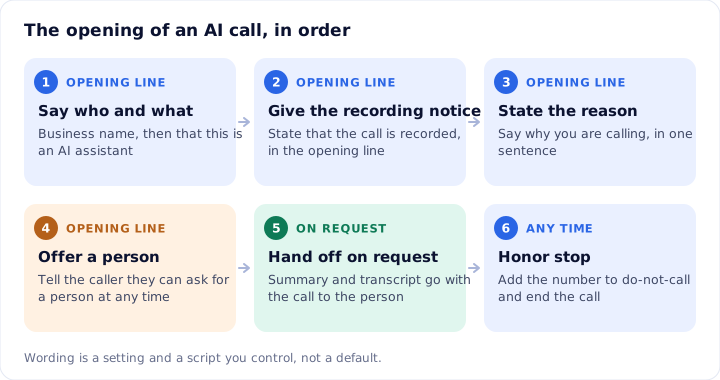
- Say it is an AI in the first sentence, say the call is recorded, and let the caller reach a person. One opening meets the strictest rules below.
- Four rules differ: AI disclosure, consent to call, recording consent and data use. A rule that covers one does not cover the others.
- VoiceGenie leaves the AI announcement as a setting, not a default. We recommend you switch it on for every agent.
What the rules say about AI calls, in short
Tell the caller it is an AI in the first sentence, say the call is recorded, have consent for the call itself, and let the caller reach a person at any time. Few laws demand all four for a phone call. Together they cover the strictest rules we found in the US, UK, EU and India.
VoiceGenie publishes this guide and sells AI calling, so read it with that in mind. The rules below are general information from public sources. Verify each one on the official site linked in the sources before you rely on it.
Four separate questions get mixed up in most advice:
- Disclosure. Does the caller know it is an AI?
- Consent to call. Did the person agree to be called, and can they stop it?
- Recording. Does the caller know the call is recorded?
- Data use. What happens to the audio, the transcript and the personal data afterward?
A law that answers one does not answer the others. A caller who is told it is an AI has not agreed to be called. A caller who agreed to be called has not agreed to be recorded by a third party.
Tell callers it is an AI, and say it early
Do it in the first sentence. Callers who find out in the middle of a call feel tricked, and in a growing list of places, tricking them is the legal problem. The rule is usually about deception, not about the word "AI."
Disclosure is the least settled of the four. No US federal rule requires it on a call today. The FCC proposed one in August 2024: a clear disclosure at the start of each outbound AI-generated call. That was a proposal, and we found no final rule [2]. Inbound calls were left out of that proposal [2]. States are moving faster, but their laws differ in what they reach:
- Maine requires a clear and conspicuous notice when a chatbot could lead a reasonable consumer to believe it is a human, and enforces it under its unfair trade practices law [6]. It took effect on 24 September 2025 [7].
- Utah requires disclosure when a person asks, and up front in "high-risk" interactions. The law runs to July 2027 [7].
- California makes it unlawful to use a bot to knowingly deceive a person about its artificial identity online, to sell goods or influence a vote, unless the bot is clearly disclosed [5]. The text says "online." Whether it reaches a phone call is untested, so treat it as a signal, not a safe harbor.
- California and New York also have companion-chatbot laws. They target relationship-style apps, not business call agents [7].
The practical answer is the same everywhere: say it. A caller who hears "this is an AI assistant" and stays on the line has made an informed choice.
A script for the first line
Here is an opening that covers disclosure, recording and a way out. Write it into the agent's opening line, in your own words.
"Hi, this is an AI assistant calling for Northside Dental. This call is recorded. I'm calling to confirm your visit on Thursday. You can ask for a person at any time."
The recording notice is not a separate switch in VoiceGenie. It is part of the words you write, so check that it is there on every agent.
Consent to call and recording notice
Consent is where outbound AI calls get risky in the US.
Consent to call. In February 2024 the FCC ruled that AI-generated voices are "artificial" voices under the TCPA. Calls using them need the called party's prior express consent, and calls with an ad or telemarketing need prior express written consent [1]. That ruling did not ban AI calls. It said the existing consent rules already apply. For telemarketing with prerecorded voices, the FTC adds that the agreement must be written, direct from the consumer and not a condition of purchase [3].
Stopping. Whatever the law says, honor "stop calling me" on the first ask. VoiceGenie can set quiet hours, retry limits and do-not-call suppression. Set all three before a campaign starts, and decide who owns the do-not-call list.
Recording. Federal US law needs one party's consent. The Reporters Committee lists 13 states that require all parties to consent to phone-call recording: California, Connecticut, Delaware, Florida, Illinois, Maryland, Massachusetts, Michigan, Montana, Nevada, New Hampshire, Pennsylvania and Washington [4]. You rarely know where a caller is sitting. So state the recording at the start, as in the script above.
| Question | US | UK | EU | India |
|---|---|---|---|---|
| Must you say it is an AI? | No federal rule for calls; FCC proposal only [2]. Maine, Utah and others by state [6][7]. | No AI-call statute found; deception is the risk | Yes, from 2 Aug 2026, unless obvious [9] | No national rule found |
| Consent to call | Prior express consent; written if marketing [1] | Specific consent for automated marketing calls [8] | Check national rules and GDPR | Promotional robocalls on 140 series [11] |
| Recording notice | One-party federally; 13 all-party states [4] | Tell callers; data-protection law applies | Tell callers; GDPR applies | No national rule found |
| Human access | Not required by statute for calls | Not required by statute for calls | GDPR Art 22 for solely automated decisions [10] | Not required by statute for calls |
Cells that say "no rule found" mean we did not find one on a regulator page. They do not prove none exists.
The rules by country
This section is general information gathered from public sources, checked 17 Nov 2026. Rules change, so check the regulator's own site before you rely on any of it.
United States
Four layers apply. The federal consent rules for calls (TCPA and the FCC ruling) [1], the FTC's Telemarketing Sales Rule for sales calls [3], state recording laws [4], and state bot-disclosure laws [5][6][7]. Do not assume your state is quiet because it is not on the disclosure list. Some commentators say state attorneys general may argue that an undisclosed bot is an unfair or deceptive practice even without a bot-specific law, though the merits of such claims are questionable [7].
United Kingdom
We found no UK law that requires a phone bot to say it is an AI. The binding rules are about calling. Under PECR, automated marketing calls need consent that specifically covers automated calls, a name plus a contact address or freephone number, and a displayed number. Live marketing calls must be screened against the TPS and CTPS [8]. Data-protection rules then govern the recording and what you keep.
European Union
Article 50 of the AI Act says AI systems intended to interact directly with people must be designed so that people are informed they are dealing with an AI, unless it is obvious to a reasonably well-informed, observant person. The information must come at the latest at the first interaction, in a clear way [9]. The article applies from 2 August 2026 [9]. The duty in paragraph 1 is written for providers, so a deployer should expect its vendor to build it in, and should still say it in the script. Separately, GDPR Article 22 limits decisions based solely on automated processing that have legal or similarly significant effects, and where it allows them, requires safeguards including a right to human intervention [10].
India
We found no national law that requires an AI call to announce itself. The telecom rules do shape the call. TRAI's 2025 amendment says promotional auto-dialer or robocalls go out on 140-series numbers and service or transactional ones on the 1600 series, and senders must notify their access provider about auto-dialer use [11]. The Digital Personal Data Protection Rules were notified on 14 November 2025 with an 18-month phased compliance timeline, and they call for clear, standalone, purpose-specific consent notices [12]. Plan your consent wording for that.
Callers who need a person, and bias
A way to reach a person
Gartner reported in 2026 that 87% of customers say access to a human agent is essential when companies use generative AI in customer service [13]. That is about trust, not law. So build the exit in:
- Say at the start that a person is available.
- Hand off on request, on the first ask, with no "are you sure?" loop.
- Hand off on distress, confusion, anger, bereavement or a mention of a health emergency, without waiting to be asked.
- Pass the summary, transcript, the caller's mood and what the AI already did, so the caller does not repeat themselves. VoiceGenie's hand-off carries all of that.
- Keep the AI away from decisions that need judgment: complaints, hardship, disputes, safety.
Vulnerable callers
Older callers, callers in distress, callers with hearing or speech differences and callers who are simply confused are the ones most harmed by a bot that will not let go. Write the triggers into your script and test them with real recordings. Review any call where the caller asked for a person twice.
Accents and bias
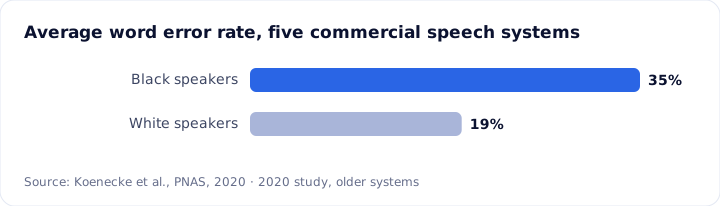
A 2020 study in PNAS tested five commercial speech-recognition systems and found an average word error rate of 0.35 for Black speakers against 0.19 for white speakers [14].
You cannot fix this by reading a vendor's claim. Measure it. Split failures, misheard names, repeat requests and hand-offs by language and accent. Listen to the failed calls. If one group fails twice as often, change the script, the language or the route to a person for that group before you scale.
Data use and model training
Before you sign with any voice AI vendor, ask in writing:
- Is call audio, or are transcripts, used to train any model? Whose, and can you opt out?
- Where are recordings stored, for how long, and who can play them?
- Is personal data redacted in transcripts, such as card numbers?
- What do you get after every call? On VoiceGenie, a webhook after every attempt carries the full conversation record and post-call analysis, so you can store it in your own systems.
- What happens to a caller's data when they ask you to delete it?
We cannot answer the training question for you from this page. Ask us and every other vendor, and get the answer in the contract. On security, VoiceGenie's security program is built to the SOC 2 Type 2, ISO 27001 and ISO 42001 standards, and it handles personal data in line with GDPR. Security documentation is shared on request. Customers cannot bring their own AI model into VoiceGenie, so ask which models process your audio.
A checklist you can use tomorrow
Tick every line before an AI agent takes a real call.
- The AI announcement is switched on for this agent, and the first sentence says it is an AI.
- The opening line includes the recording notice.
- Every outbound number has consent that covers an AI voice, and you can find the record.
- Quiet hours, retry limits and do-not-call suppression are set. A stop request ends calls on the first ask.
- A caller can reach a person at any time, and the hand-off passes the full context.
- Distress and complaint triggers route to a person.
- The vendor has told you in writing how call data is used and kept.
- You have listened to a sample of failed calls, split by accent and language.
- Someone owns the rule check for each country you call, with the regulator pages saved.
For a longer list of what goes wrong in set-up, read mistakes to avoid when setting up an AI caller. If you are new to the technology, start with what an AI voice agent is. For outbound sales, which has the strictest consent exposure, read voice AI for cold calling.
When VoiceGenie is the wrong choice
Be candid about fit. VoiceGenie leaves the AI announcement and the recording notice in your hands. If you want a vendor that forces both on every call and cannot be configured otherwise, ours is not that tool today, and that is why we advise the settings above. AI calls are billed per minute, at $0.14 per minute, billed per second, and you bring your own carrier and numbers, so consent, caller ID and number reputation stay your responsibility. If you want the help of a team, a managed service sets up and maintains the agents. See the pricing page or how support teams use AI calls. The 14-day human agent trial and $2 of AI wallet credit are enough to test the opening line on your own team before any real caller hears it.
Common questions
Do I have to tell callers they are talking to an AI?
Not everywhere by statute, but you should. Maine requires a clear notice when a chatbot could mislead a reasonable consumer into thinking it is human, and the EU AI Act requires it from 2 August 2026. Other places rest on consumer-protection law. Saying it in the first sentence meets every rule we found.
Can I use an AI voice to call people without consent in the US?
Usually no. The FCC ruled in 2024 that AI-generated voices are artificial voices under the TCPA, so calls need the called party's prior express consent. A call with an ad or telemarketing needs prior express written consent. Exemptions are narrow. Check the FCC ruling and your state rules before dialing.
Do I need to tell callers an AI call is being recorded?
Yes, as a practice. Federal US law needs one party's consent, but 13 states require all parties for phone calls, and you rarely know where a caller sits. State the recording at the start of every call. On VoiceGenie the notice is written into the agent's opening line.
What if the caller asks for a human?
Give them one, quickly, with no argument. The EU's GDPR gives a right to human intervention for solely automated decisions with serious effects, and Gartner reported in 2026 that 87% of customers say access to a person is essential. Pass the summary and transcript so they do not repeat themselves.
Can a voice bot be biased against accents?
Yes. A 2020 PNAS study of five commercial speech systems found an average word error rate of 0.35 for Black speakers and 0.19 for white speakers. Older systems were tested, so measure your own callers: compare hand-off and failure rates by language and accent, and listen to the failed calls.
Sources
- FCC, Declaratory Ruling FCC 24-17 on AI-generated voices under the TCPA, 2024
- Kelley Drye, FCC proposes new TCPA rules for AI calls and texts, 2024 (summary of the FCC proposal)
- FTC, Q&A for telemarketers and sellers about DNC provisions in the Telemarketing Sales Rule
- Reporters Committee for Freedom of the Press, Reporter's Recording Guide: Introduction
- California Business and Professions Code section 17941 (bot disclosure), as published on California Public Law, checked 17 Nov 2026
- State of Maine, H.P. 1154 / L.D. 1727, chatbot disclosure (10 MRSA 1500-Y)
- Cooley, AI Chatbots at the Crossroads: Navigating New Laws and Compliance Risks, Oct 2025
- UK ICO, Telephone marketing (PECR guidance)
- EU Artificial Intelligence Act, Article 50 (transparency obligations)
- GDPR, Article 22 (automated individual decision-making)
- TRAI, Telecom Commercial Communications Customer Preference (Amendment) Regulations, Feb 2025
- Press Information Bureau, Government notifies DPDP Rules, 14 Nov 2025
- Gartner, Only 27% of Customers Would Try a Chatbot Again After a Negative Experience, 2 Sep 2026
- Koenecke et al., Racial disparities in automated speech recognition, PNAS, 2020 (via PMC Q&A)
About this post. The rules, prices and figures here were gathered from public sources and were correct to the best of our knowledge on the date shown. They change, and they differ by country and state. This is general information, not legal or financial advice. Before you act, check the latest position with the regulator or company concerned, using the links above. If you spot an error, write to support@voicegenie.ai.
Founder and CEO of VoiceGenie. Writes about how AI agents and human teams share the phone work, and what it takes to run them on real calls.
More posts by Anurag Jain