
- Callers hang up when there is no way to reach a person, the opening runs long, or digits are read wrong. Each has a fix you can set before launch.
- The legal mistakes are consent, calling hours, recording notice and ignoring a stop request. US rules are summarized here; check each with the official source.
- Judge an agent on a written test set of about 40 calls and 20 real calls you listen to, never on a demo.
The eight mistakes that make callers hang up or put you at risk
The mistakes that cost most are small ones made at setup: no route to a person, an opening line that runs long, digits read wrong, calling without consent, calling at the wrong hour, automating the wrong calls, skipping a test set and judging by a demo. Each is cheap to fix before launch and costly after it.
Disclosure: VoiceGenie publishes this guide and is one of the tools you could use. The advice holds for any AI caller. It is written from the caller's side, because the caller decides whether the call lasts. Rules here are US rules unless stated; verify them with the official source linked.
| Mistake | What the caller experiences | Fix |
|---|---|---|
| No exit to a person | "Agent" is said three times and the bot keeps going. The caller hangs up and tells someone. | Hand off on the words people use and on frustration. Pass the summary along. |
| Long opening line | Fifteen seconds of company name, notice and offer before the caller can speak. | Name, reason, one question, in a breath. Put the recording notice in the same line. |
| Reading digits wrong | A phone number read as one long number, an amount read as a year. | Group digits, say amounts in words, read back and ask "is that right?" |
| No consent | A call from a number they never gave, which they may report. | Get and store consent. Suppress stop requests everywhere. |
| Wrong hours | The 9:12 pm call about an order. | Set quiet hours by the contact's time zone. Cap retries. |
| Automating the wrong calls | A distressed caller gets a cheerful script. | Keep disputes, complaints and bad news with people. |
| No test set | The agent breaks on the first caller who mumbles or interrupts. | Write 40 test calls and rerun all of them after each change. |
| Judging by demo | It sounded perfect in the meeting and fails on a bad line. | Listen to 20 real calls before you scale. |
No exit to a person, and why it is the worst mistake
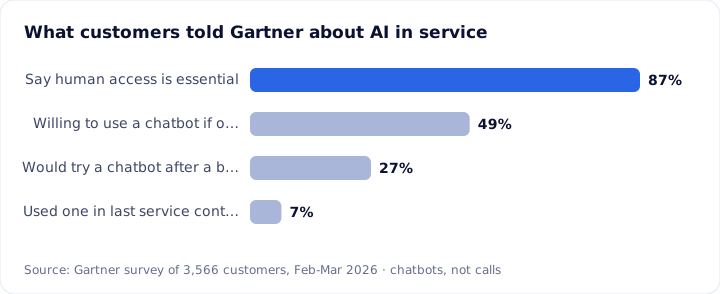
Callers will forgive a clumsy sentence. They do not forgive being trapped. In a 2026 Gartner survey of 3,566 customers, 87% said access to a human agent is essential when companies use generative AI in service [6], and only 27% said they would be willing to try a chatbot again after a negative experience [1]. The 27% is stated willingness, not measured behavior. That survey covered chatbots, not phone calls, but the finding fits the phone: one bad run and the caller does not come back.
What to set up:
- A hand-off on plain requests: "agent", "person", "human", "manager", "representative", in each language you call in.
- A hand-off on frustration: a caller who repeats themselves twice, raises their voice or says "this is useless".
- A hand-off on topics the agent must not handle: disputes, complaints, anything that needs a decision.
- A person who actually picks up. Check staffing for the hours the agent calls. A transfer to a closed desk is the same mistake with extra steps.
When VoiceGenie hands a call to a person, that person sees a summary, the transcript, the caller's mood and what the AI already did, so the caller does not start over. The screen below shows what that looks like from the agent's side.

Long openings and wrong digits: the two things callers hear first
The first four seconds decide whether the caller stays. A typical bad opening names the company, announces the recording, reads a disclaimer and pitches, all before the caller says hello back. Cut it to four parts: who is calling, why, one question, and the notice that matters. Our rule of thumb: if you cannot say it in one breath, it is too long. This is our practice, not a measured benchmark.
Two notices belong in that opening. First, tell people it is an AI. On VoiceGenie the AI announcement is a setting you switch on per agent, and it is off by default, so switch it on. Second, if the call is recorded, say so. VoiceGenie has no separate recording-notice setting, so you write it into the agent's opening line.
Digits are the other early failure. A phone number read as "nine hundred eighty seven million" makes a caller doubt everything after it.
- Read phone numbers in groups of three, three and four.
- Say amounts in words ("forty-two dollars and fifty cents") and dates with the weekday.
- Read back anything the caller gives you and ask for a yes.
- When a code or link matters, send it by text rather than speaking it. One-time codes go through your SMS provider or your own API, triggered by the agent.
Here is how a short reminder opening sounds when it is built this way.
Hello Daniel, I'm calling from City Care Clinic. You have an appointment with Dr Mehta tomorrow at eleven in the morning. Will you be able to make it, or would you like me to move it to another time?
In English: Hello Daniel, I'm calling from City Care Clinic. You have an appointment with Dr Mehta tomorrow at eleven in the morning. Will you be able to make it, or would you like me to move it to another time?
Consent, hours and stop requests: the mistakes that put you at legal risk
This is general information gathered from public sources, last checked 17 Nov 2026. Rules change, so check each one on the regulator's own site (FCC, FTC, CFPB or your state) before you rely on it. Where a rule applies, the country is named.
| Mistake | Rule | Country | What it means |
|---|---|---|---|
| Calling without consent | TCPA, FCC 24-17 | US | AI-generated voices count as artificial voices, so prior express consent is needed, and written consent for telemarketing [2]. |
| Calling at the wrong hour | Telemarketing Sales Rule | US | No calls to a residence before 8 a.m. or after 9 p.m. at the called person's location, absent consent [3]. Some states are stricter. |
| Too many calls | Regulation F, for debt collectors | US | More than seven calls in seven consecutive days about one debt is presumed to violate the rule, though the presumption can be rebutted [5]. |
| Ignoring a stop request | Telemarketing Sales Rule | US | A person who said they do not want calls must not be called again by that seller [3]. |
| Recording with no notice | State wiretap laws | US | Federal law needs one party's consent; 13 states are listed as all-party for phone calls [4]. |
| Answered calls left with no one to talk to | Telemarketing Sales Rule | US | A call is abandoned if not connected to a sales representative within two seconds of the person's greeting. The rule's safe harbor requires no more than 3% abandoned per campaign, among other conditions [3]. |
Three setup moves cover most of this. Store the consent record with its date and wording for each contact. Set quiet hours by the contact's time zone and retry limits per contact, which VoiceGenie supports along with do-not-call suppression. And treat "stop calling me" in any wording as final, across every campaign, not just the one it was said on. If you call across states, apply the strictest rule you meet.
For calls with a seller, see how lead qualification works with consent and quiet hours.
Automating the wrong calls
An AI caller is good at calls with one right answer: a reminder, a confirmation, a booking, a status check. It is poor at calls where the caller is upset, the answer depends on judgment, or money and rights are involved. The mistake is picking the call by volume, not by what a wrong answer costs.
Sort your calls by the cost of a wrong answer. If it costs a repeat call, automate it. If it costs money or a complaint, let the AI collect facts and a person decide. If the caller is distressed, go straight to a person. A caller who says "my mother died" in the middle of a payment reminder should never hear "Great, thanks for letting me know."
Add triggers for these words and phrases to the hand-off list. And do not stretch the agent to extras it does not need. A calendar booking agent that also answers pricing and handles returns is three agents with one prompt and none of them tested. Start with one call type. Our guide to beginners building an AI voice bot covers the choice in more detail.
No test set, and judging by demo
A demo is one good call on a good line with a cooperative person. Real callers mumble, interrupt, give the wrong date and ask something off the script. A test set is the written list of calls you run every time you change anything. Without one, every fix is a guess and you will not know what broke.
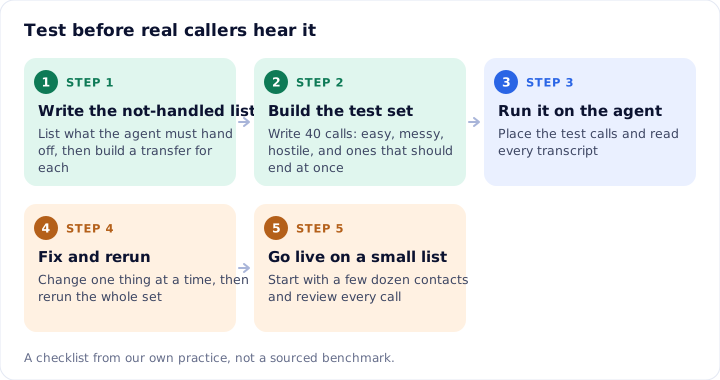
The plan, in the order you do it:
- Write the not-handled list. List what the agent must hand off, then build a transfer for each item.
- Build the test set. Write 40 calls: easy ones, messy ones, hostile ones, and calls that should end at once, such as "take me off your list".
- Run it on the agent. Place the test calls and read every transcript.
- Fix and rerun. Change one thing at a time, then rerun the whole set.
- Go live on a small list. Start with a few dozen contacts and review every call.
The numbers 40 and 20 are our own rule of thumb, not a standard. Scale them to your volume. What matters is that you listen to real calls. Every attempt on VoiceGenie sends a webhook with the full conversation record and post-call analysis, so you can pull transcripts into your own review sheet. For what to track afterward, read how to measure the success of an AI voice bot.
Make sure the launch plan tests the stop path. Place a call, say "stop calling me", and check that the contact is removed from every dialing sequence. The API can remove a contact from a multi-step sequence, and your test should prove it did.
When AI calling is the wrong choice
Skip it, or wait, in these cases:
- You have no consent record. Fix that first.
- No person is available when the agent calls. A hand-off needs someone at the other end.
- Most of your calls need judgment. An AI front door saves little.
- You want the call to say whatever the sales team thinks of that day. An untested script is worse than no call.
On fit: VoiceGenie offers AI agents and a human agent desk, and you bring your own carrier and numbers. AI agents are usage based, at $0.14 per minute, billed per second. A 14-day trial of the human agent platform comes with $2 of wallet credit to test AI agents, and you can set up yourself or have VoiceGenie's team set up and maintain the agents. You cannot bring your own AI model. VoiceGenie's security program is built to the SOC 2 Type 2, ISO 27001 and ISO 42001 standards, and it handles personal data in line with GDPR. Security documentation is shared on request. Prices are on the pricing page. If you only need a human-only desk, a narrower tool may suit you better.
Common questions
What is the most common AI caller setup mistake?
Leaving no way out. If a caller asks for a person and the agent keeps talking, they hang up angry. Set a hand-off for the words people use, such as agent, human or manager, and for signs of frustration. Test it on day one, because it is the mistake callers punish hardest.
Do I have to tell people an AI is calling?
Disclose it. The FCC treats AI-generated voices as artificial voices under the TCPA, which brings consent rules, and no one wants a caller to feel tricked. On VoiceGenie the AI announcement is a setting you switch on per agent. Verify the rules for your state and country with the official source.
What hours can an AI caller call?
In the US, the Telemarketing Sales Rule bars calls to a residence before 8 a.m. or after 9 p.m. at the called person's location without consent. Some states are stricter. Set quiet hours by the contact's time zone, not yours, and cap retries. Check your own state's rule with the official source.
Should an AI caller record the call?
Say so in the opening line. Federal law needs one party's consent, but the Reporters Committee lists 13 states with all-party rules for phone calls, so tell everyone at the start. VoiceGenie has no built-in recording notice setting. You write it into the agent's opening line.
How do I test an AI caller before launch?
Write about 40 test calls: easy ones, messy ones, hostile ones, and calls that should end quickly. Run all of them, read every transcript, fix one thing at a time and rerun the whole set. Then go live on a few dozen real contacts and listen to every call that week.
Sources
- Gartner, Only 27% of Customers Would Try a Chatbot Again After a Negative Experience, press release, 2 Sep 2026
- FCC, Declaratory Ruling FCC 24-17 on AI-generated voices under the TCPA, 2024
- FTC, Telemarketing Sales Rule, 16 CFR 310.4 Abusive telemarketing acts or practices
- Reporters Committee for Freedom of the Press, Reporter's Recording Guide: Introduction
- CFPB, Regulation F, 12 CFR 1006.14 Harassing, oppressive, or abusive conduct
- Gartner, Survey Finds 87% of Customers Say Companies Using GenAI for Customer Service Must Provide Access to a Human Agent, press release, 4 Aug 2026
About this post. The rules, prices and figures here were gathered from public sources and were correct to the best of our knowledge on the date shown. They change, and they differ by country and state. This is general information, not legal or financial advice. Before you act, check the latest position with the regulator or company concerned, using the links above. If you spot an error, write to support@voicegenie.ai.
Content marketing associate at VoiceGenie. Writes guides on setting up and running AI voice agents.
More posts by Rohit Singh