
- True cold calling with an AI voice is unlawful in the US without prior consent, and restricted in the UK and India. Do not build a program on it.
- The legitimate lanes are warm: inbound-lead call-back, opted-in lists, event follow-up, and some business calls. The AI qualifies and books; the rep sells.
- Cold-call answer rates are low, about 13% in one large dataset. The gain from AI is speed and coverage on warm leads, not a better cold dial.
Can you use AI for cold calling?
Not for true cold calls. In the US, an AI voice counts as an artificial voice, so calling people who never agreed to hear from you is unlawful without prior consent [1]. The UK requires consent for automated marketing calls, and India restricts telemarketing calls. AI works well on warm outbound: leads who asked for a call, opted-in lists, event follow-up and some business calls.
Disclosure: VoiceGenie publishes this guide and sells AI calling, so we gain if you buy. We also lose nothing by telling you which half of the idea is off limits. Our sales teams page covers the operating model for the whole team. This post is narrower. It answers what a reader typing "AI cold calling" is actually trying to decide: what is allowed, what to expect, and how a call should go.
This is not a guide to getting around calling rules, and it will not teach you to. If your plan depends on dialing strangers with an artificial voice, no tool, ours included, fixes that.
What the law says in the US, UK and India
The short version is below. It is general information gathered from public sources, with no legal review. Verify each rule on the regulator's own page, linked in the sources, before you rely on it.
| Country | Rule | What it means for an AI caller |
|---|---|---|
| US | TCPA, FCC ruling FCC 24-17 | AI-generated voices are artificial voices. Prior express consent is needed, and telemarketing needs prior express written consent [1]. |
| US | 47 CFR 64.1200 | Written consent is a signed agreement naming the number. Honor a do-not-call request for 5 years [2]. |
| US | FTC Do Not Call rules | Most calls to a business to solicit sales are exempt from the registry. A consumer inquiry opens a 3-month window, and a purchase opens 18 months [3]. |
| US | Opt-outs | From 25 Nov 2026, an opt-out of a marketing call or text covers all future marketing calls and texts from that caller [4]. |
| UK | PECR | Automated calls need the person's specific consent. Live calls need screening against TPS and CTPS [5]. |
| UK | B2B calls | Automated calls need the business's consent, and the same applies to sole traders. Live calls need screening against both registers [6]. |
| India | TRAI TCCCPR rules | Promotional calls use the 140 series and service calls the 1600 series. Consent for a transaction lasts 7 days [7]. |
Three points matter more than the rest.
Consent is the gate, not the script. The FCC ruling does not ban AI calls. It says the artificial-voice consent rules already apply to them [1]. A perfect opener cannot repair a call that should not have been placed.
The business-call exemption is narrower than it sounds. The FTC exemption is about the Do Not Call registry [3]. It does not remove the written-consent rule for artificial voices to mobile phones, and the rule text I read has no carve-out for a business cell phone [2]. In the UK, a work number counts as a corporate subscriber, and automated calls still need that business's consent [6]. If you call business lines, confirm the rule for your country and number type on the regulator's own site first.
India is less settled. I found no TRAI text that addresses AI voices by name. A law-firm summary from March 2026 says the 2018 regulations do not yet treat AI as a risk category, that AI disclosure rules are under consideration, and that ordinary 10-digit mobile numbers cannot be used for telemarketing [8]. It also notes a court challenge, listed for hearing in March 2026, on whether the complaint rules apply to business calls [8]. I could not confirm its outcome. Use the 140 and 1600 series correctly, and treat the AI question as open.
Where AI outbound is legitimate: warm calls
A warm call is one the person would expect. The consent comes first, and the AI is how you act on it quickly. Most of the value is in speed. In a 2013 test of 9,538 companies, 47% never responded to a web inquiry, and those that phoned took a median of 3 hours 8 minutes [11]. That study is old and measured response, not sales, but the gap it describes is the opening.
| Lane | Example | What you need on file |
|---|---|---|
| Inbound-lead call-back | A demo form submitted at 9:12 pm, with call consent in the form | The consent wording, the number and the time |
| Re-engaging an opted-in list | Contacts who agreed to calls and went quiet 60 days ago | Opt-in record per contact; honor any opt-out |
| Event follow-up | Badge scans where the attendee agreed to be contacted | The consent given at the booth or in the app |
| Missed-call return | Someone called your sales line and hung up at voicemail | Treat as an inquiry; check the legal window |
| Business-to-business calls | Calls to companies, where the rules differ | The rule for your country, number type and state, checked on the regulator's site |
What is not on the list is a purchased list of strangers. If the only record you have is a name, a number and a job title, you do not have consent.
What the AI does and what the rep does
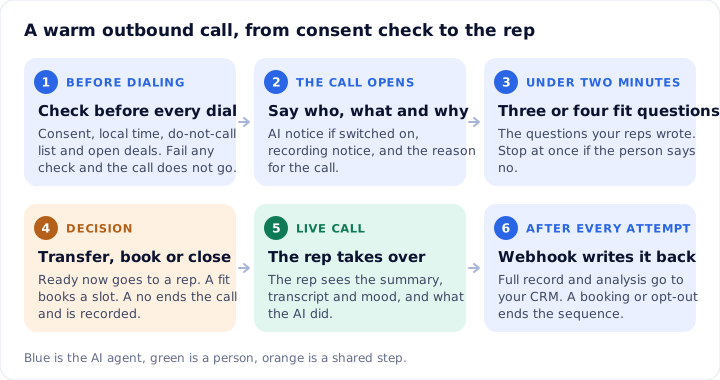
Split the call by what it needs. The AI covers the fast, repeatable part. The rep keeps judgment, trust and money.
| Task | AI | Rep |
|---|---|---|
| Check consent, local time, do-not-call and open deals | Yes, before the dial | Sets the rules |
| First call within a minute of a form | Yes | |
| Three or four fit questions | Yes | Writes the questions |
| Booking, reminders, reschedules | Yes | |
| Discovery, objections, pricing | Yes | |
| Named accounts and open deals | Flags to the owner | Yes |
| Notes and next step | Writes the record | Reviews it |
VoiceGenie covers the AI half and the person half on one record. You can start a call by API, set quiet hours and retry limits, suppress numbers on a do-not-call list, and remove a contact from a multi-step dialing sequence when they book or opt out. After every attempt, a webhook sends the full conversation record and post-call analysis to your CRM. When the AI hands off, the rep sees a summary, the transcript, the caller's mood and what the AI already did. You bring your own carrier and numbers. For the rep side, see AI voice agent vs human SDR.
A point of view: do not ask the AI to win an argument. A short, honest qualification call that books a person beats a long pitch from a voice that cannot read the room. Buyers are also wary. In a December 2023 Gartner survey of 5,728 customers, 64% said they would prefer companies not use AI in customer service, mostly from fear of not reaching a person [12]. That is a customer-service survey, not a sales one, but the worry carries over.
of 9,538 companies analyzed never answered a web inquiry; those that phoned took a median 3 h 8 min (InsideSales, 2013)11
of 6,346 forms got no email reply; about 100 got a phone call, after 34.5 hours on average (Clay audit, 2026)13
of the week is spent selling; manual data entry takes 8.8% (survey of 7,775 sales professionals, Salesforce, 2022)14
median SDR attrition in 2024, with 3.0 months to ramp a new hire (Bridge Group, 351 B2B companies)10
Connect rates: what the data says
Honest answer first: no one has a neutral benchmark for AI warm calls, and I will not invent one. What exists is thin.
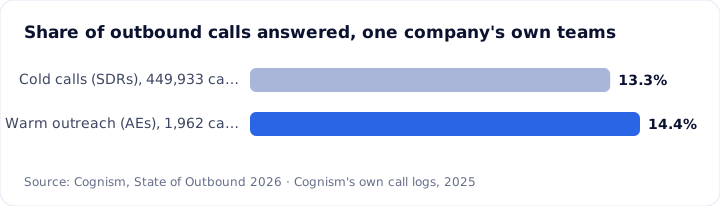
Cognism's logs from 2025 show 13.3% of 449,933 cold SDR calls answered, and 14.4% of 1,962 warm calls by account executives [9]. It is one firm's data, drawn from its own call records. Separately, in a 2025 survey of 351 B2B companies, phone-centric SDR teams made 56 dials and held 4.6 quality conversations a day [10]. That works out to about 12 dials per conversation, my arithmetic, not the study's.
What this tells you: a cold dial is a low-odds event, whoever or whatever places it. AI makes more dials cheaper, but more dials to people who did not ask for them raises complaints and legal exposure faster than it raises meetings. The better use is a short call to people who did ask, placed in the first minute. Measure your own answer rate for four weeks, by lead source, before you set a target.
A script structure for a warm call
Keep it under two minutes. Each part has a job. This is a structure, not a script to read out.
- Identify and give the reason. "Hi Priya, this is an AI assistant calling for Northbeam. This call is recorded. You asked for a demo on our site a minute ago." Turn on the AI announcement and write the recording notice into this line.
- Ask permission. "Is now a good time for two quick questions?" If not, offer two times or a text with a booking link.
- Ask three or four fit questions. What prompted the request, company size, what they use now, when they must decide. Your reps write these.
- Decide on the call. Ready now: transfer to the rep on duty with a summary. A fit but not urgent: book. Not a fit: send resources and log the reason.
- Honor a no. "Please do not call me" ends the call, records the opt-out and removes the contact from every sequence, at once.
- Close. Repeat the booked time, send the confirmation, and write everything back to the CRM.
Listen for these triggers and move to a person: a pricing objection, a named competitor, a request for a contract, an angry tone, or "get me a real person".
How to pilot it and what to measure
Start with one lane, such as call-backs to web leads that carry call consent. Run 20 staff test calls, including a price shopper, a wrong number and someone who says "stop calling me". Read every transcript.
Then measure what counts:
| Measure | Why |
|---|---|
| Minutes from form to first live attempt | The speed gain you are buying |
| Answer rate by lead source | Your own baseline, not a borrowed one |
| Meetings held, not just booked | A booked slot that no one attends is a cost |
| Rep acceptance of AI-booked meetings | Loose questions show up here |
| Opt-outs and complaints per 1,000 calls | The early warning for consent problems |
| Opt-outs honored at once | Must be 100% |
On cost, a 3-minute call is 3 minutes at $0.14 per minute, billed per second, plus your carrier. AI agents are usage based, and human agents are a per-seat license. For a 14-day trial of the human agent platform and test credit for AI agents, see our pricing page. For the follow-up calls after the first one, read automating follow-ups with a voice assistant.
When AI calling is the wrong choice
Skip it, or wait, in these cases:
- Your plan is a list of strangers. The law and customer goodwill are both against you.
- You cannot show consent per contact. If you cannot say when, how and for what a person agreed, do not dial.
- Your deal needs a long, consultative opener. A person should place that call.
- You have no rep ready to take the transfer. A warm hand-off to nobody is worse than voicemail.
- You want a larger dial count to impress someone. Volume is not a result.
On fit: VoiceGenie suits teams that already have consented leads and want a fast first call, with a person for the rest. VoiceGenie's security program is built to the SOC 2 Type 2, ISO 27001 and ISO 42001 standards, and it handles personal data in line with GDPR. Security documentation is shared on request. Customers cannot bring their own AI model, and CRMs outside HubSpot, Salesforce and Zoho connect through the open API, webhooks or Zapier. For wider team design, see voice AI for sales automation.
Common questions
Is AI cold calling legal?
Not in the sense most people mean. In the US, the FCC ruled in 2024 that AI-generated voices are artificial voices under the TCPA, so calls need prior consent, and telemarketing calls need written consent [1]. The UK requires specific consent for automated marketing calls [5]. Calls to people who asked to hear from you are the legal lane.
Can AI call numbers on the Do Not Call list?
Not for marketing without a valid exception. Honor the national registry, and keep your own internal list, since US rules say a do-not-call request must be honored for 5 years [2]. In the UK, screen live calls against the TPS and CTPS registers [6]. A person who asked for a call, or a recent inquiry inside the legal window, is a different case.
Does the business-to-business exemption allow AI cold calls?
Not by itself. The FTC says most calls to a business to solicit sales are exempt from the Do Not Call provisions [3], but that does not remove the consent rule for artificial voices to mobile numbers [2]. In the UK, automated B2B calls still need the business's consent [6]. Treat B2B as a question to verify, not a loophole.
What is a good connect rate for outbound sales calls?
There is no neutral benchmark. In one company's own logs of 449,933 cold SDR calls, 13.3% were answered, against 14.4% of 1,962 warm calls by account executives [9]. Phone-centric SDR teams make about 12 dials for each quality conversation [10]. Measure your own list for four weeks before you set targets.
What should an AI say at the start of a sales call?
Say who is calling, why, and that the person asked to hear from you, then ask whether now is a good time. On VoiceGenie, the AI announcement is a setting you switch on per agent, and the recording notice is written into the opening line. Offer a person early and stop at once if the answer is no.
Sources
- FCC, Declaratory Ruling FCC 24-17 on AI-generated voices under the TCPA, adopted 2 Feb 2024
- 47 CFR 64.1200, Delivery restrictions (text via Cornell Legal Information Institute)
- FTC, Q&A for telemarketers and sellers about DNC provisions in the TSR
- National Law Review, FCC overhauls TCPA consent revocation rules (FCC 26-67, effective 25 Nov 2026), 2026
- ICO, Telephone marketing (PECR guidance)
- ICO, Business-to-business marketing
- TRAI, Press Release No. 11 of 2025, 12 Feb 2025 (140 and 1600 series, consent validity)
- S.S. Rana & Co., TRAI's crackdown on spam calls and AI-driven telemarketing, 9 Mar 2026 (law firm summary)
- Cognism, State of Outbound 2026 (the company's own call logs, 2025)
- The Bridge Group, SDR Models, Motions & Metrics: 2025 Research Report (351 B2B companies)
- InsideSales.com, 2014 Lead Response Report (tests run in 2013)
- Gartner, Survey finds 64% of customers would prefer companies didn't use AI for customer service, 2024
- Clay, We asked 6,346 companies for a demo. Most never wrote back. (2026)
- Salesforce, State of Sales, 5th edition (2022)
About this post. The rules, prices and figures here were gathered from public sources and were correct to the best of our knowledge on the date shown. They change, and they differ by country and state. This is general information, not legal or financial advice. Before you act, check the latest position with the regulator or company concerned, using the links above. If you spot an error, write to support@voicegenie.ai.
Founder and Chief Revenue Officer of VoiceGenie. Writes about how sales and customer teams put AI calling to work.
More posts by Maaz Ansari