- Vapi suits engineers who want to pick each model and voice. Its pricing is built from separate parts, and the person side of a call is yours to build.
- Group the alternatives by who runs them: builders for ops teams, open source for engineers, a contact-center suite for human-first teams, or AI plus a human desk.
- Test the hand-off first. Several platforms transfer the call but do not pass a summary to the person unless you build it yourself.
What to use instead of Vapi
Which Vapi alternative fits depends on who runs it and where hard calls go. Retell and Bland publish per-minute rates, and Synthflow sells a builder on an enterprise contract. LiveKit suits engineers who want open source. Dialpad suits human-first contact centers. VoiceGenie suits teams that want AI calls and a human desk on one record.
Disclosure: VoiceGenie publishes this post and is one of the options. Facts about other companies come from their own pages, opened on 17 Nov 2026, so they may have changed since. For a wider guide to the whole category, read our buyer's guide to AI phone calling platforms. This post stays on one question: you use or are weighing Vapi, so who else is worth a test?
What Vapi is good at, and why people look elsewhere
Vapi is a developer platform. Its pricing page splits a call into parts: a hosting fee of $0.05 per minute, then the transcriber, the language model, the voice and the phone transport, each passed through at cost [1]. That is useful if you want to choose each provider and swap them. Its example for 1,000 minutes a month comes to $82 to $129 in total, including a $50 hosting fee [1]. It also lists free Vapi telephony and SIP, a $5 starting credit, and plans from a Core package at 29 dollars a month up to a Pro plan with a $999 monthly minimum [1].
Four things on Vapi's own pages are worth checking before you commit.
- The bill is built from parts. Your cost per minute depends on the model, voice and phone provider you choose, so a finance lead cannot read one number off a page [1].
- Limits start low. The no-package tier lists 4 concurrent calls, and extra concurrency is $10 per line per month [1]. A campaign that dials 30 people at once needs a higher plan.
- Compliance is priced as an add-on. The page lists HIPAA compliance at $2,000 per month [1].
- The person side is yours to build. Vapi's docs describe a transfer tool that sends the live call to a phone number or SIP address. Transfers are blind by default. The warm modes that speak a summary to the person are Twilio-only, while on Vapi numbers and bring-your-own SIP trunks a summary can travel in a SIP header and is never spoken [2]. Someone has to build what the agent at the other end sees.
None of this makes Vapi a poor choice. If your team writes code and wants control, those same traits are the reason to stay. The rest of this post is for teams where one or more of the four above is the problem.
Six alternatives, grouped by what they suit
If you want a builder rather than an API
Retell AI lists pay-as-you-go voice agents at $0.07 to $0.31 per minute, with a worked example of $0.11 per minute made of model, voice infrastructure and voice parts [3]. It includes 20 concurrent calls free and bills silence and hold time [3]. Its transfer docs describe cold transfers and warm transfers, where a whisper message or a three-way introduction that you write reaches the person. An agentic warm transfer passes the conversation to a transfer agent, and the docs do not say a summary reaches the human automatically [4]. Its pricing page contradicts itself on the verified phone number fee, so confirm that with Retell [3]. For more detail, see our Retell alternatives post.
Bland AI lists a Start plan at 14 cents per minute with no monthly fee and a Build plan at $0.12 per minute plus $299 a month. Both list a per-minute rate for transfer time, $0.05 and $0.04, which does not apply if you bring your own carrier [5]. Model, speech-to-text and voice are in the per-minute rate, and phone service is billed separately [5]. See also our Bland alternatives post. I did not find how its transfer hands context to a person on the pages I opened.
Synthflow sells on an annual enterprise contract with no per-minute rate, no free plan and no trial [6]. Its home page describes a visual flow builder and phone connections to Five9, RingCentral, Twilio and others [7]. It also states security claims, including SOC 2 Type II and ISO 27001 [7]. Treat those as the company's own claims and ask for the documents. See also Synthflow alternatives.
If you are an engineering team that wants more control than Vapi gives
LiveKit Agents is an open-source framework you can run yourself, with a cloud option. Its Build plan is $0 a month with 1,000 agent session minutes, and its calculator example totals about $0.048 per minute for a phone call [10]. That example uses one small model and its own speech and phone components, so your number will differ. The trade-off is effort: you assemble the agent in code, and the pricing page does not mention human transfer [10].
ElevenLabs Agents suits teams that care most about voice quality and language range. Its docs describe a transfer tool with a default conference mode and a SIP option. Warm transfers, where the operator hears a summary first, are documented for Twilio, with the legacy note that SIP transfers do not support it, and Exotel's warm option is listed under Twilio's name, so check it [9]. Its API pricing page lists $0.08 per minute for the Speech Engine and Realtime API, but not a single all-in agent rate, so ask for a quote or check the live calculator [8].
If the team is human-first and AI is an add-on
Dialpad is a contact-center and phone suite. Its Support plans list $89, $119 and $149 per user per month, and its Connect phone plan lists a 14-day trial [11]. Its AI agents are sold on custom, conversation-based credits [11]. It suits a team that already lives in a seat-based phone system. It is not a developer toolkit, and I could not find a public description of how an AI agent hands off to a person.
If you want AI calls and a human desk on one record
VoiceGenie is our own product. AI agents are billed per minute, billed per second, at $0.14 per minute, and human seats start at $29 per month on annual billing. You bring your own carrier and numbers. When a caller needs a person, the person sees a summary, the transcript, the caller's mood and what the AI already did. You can set up agents yourself or ask our team to set up and maintain them. Pricing is on our pricing page.
Side by side, checked 17 Nov 2026
| Option | Pricing model | Hand-off to a person | Suits | Trade-off |
|---|---|---|---|---|
| Vapi | Per minute, parts billed at cost plus hosting [1] | Transfer to a number or SIP, blind by default [2] | Engineers who pick each provider | Cost and person side assembled by you |
| Retell AI | Pay as you go per minute [3] | Cold or warm transfer, no automatic summary stated [4] | Teams wanting a builder and a clear estimate | Hold and silence billed; page inconsistent on number fee [3] |
| Bland AI | Per minute, with a monthly fee on Build [5] | Transfer fee unless you bring your carrier; context hand-off not found [5] | Outbound-heavy teams | Phone service billed separately [5] |
| Synthflow | Annual enterprise contract [6] | Escalation paths scoped in the contract [6] | Mid-market and enterprise, BPOs | No public price or trial [6] |
| ElevenLabs Agents | Usage based; $0.08 per minute listed for Speech Engine [8] | Conference or SIP transfer, warm on Twilio [9] | Voice quality and languages | Needs build effort; no single agent rate on page [8] |
| LiveKit Agents | Free tier, then session minutes [10] | Not described on pricing page [10] | Engineering teams, self-hosting | You build and run it |
| Dialpad | Per seat, AI on custom credits [11] | Human-first suite; AI hand-off not found [11] | Human-first contact centers | AI price not public |
| VoiceGenie | AI per minute, human per seat | Summary, transcript, mood, AI actions | AI and people on one record | See next section |
Where VoiceGenie is the wrong choice
State the trade-offs before you test us.
- You want to bring your own model. You cannot. VoiceGenie does not let customers bring their own AI model. If you need to pick the model, Vapi, LiveKit or Retell fit better.
- You want deep code-level control. We offer a start-call API, a way to remove a contact from a dialing sequence and webhooks after every attempt with the full conversation record. That is less than a framework like LiveKit.
- You have no use for a human desk. If every call stays with the AI, you pay for a part of the platform you will not use. A pure builder is leaner.
- You need a native connector to a specific system. CRMs such as HubSpot, Salesforce and Zoho connect directly. Other systems connect through the open API, webhooks or Zapier.
- You need certificates today. VoiceGenie's security program is built to the SOC 2 Type 2, ISO 27001 and ISO 42001 standards, and it handles personal data in line with GDPR. Security documentation is shared on request.
How to choose in five steps
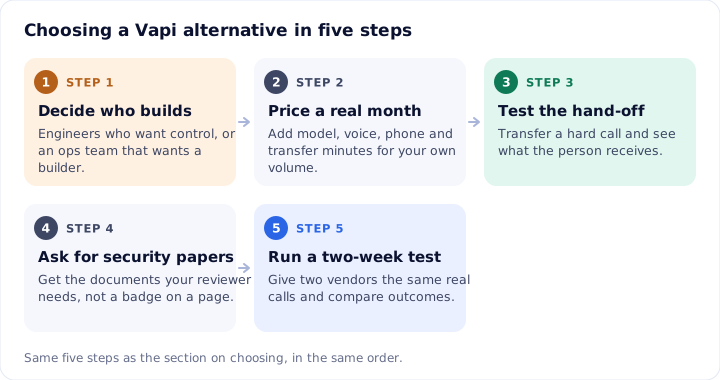
- Decide who builds. If engineers will maintain agents and want control, stay with a developer platform such as Vapi, LiveKit or Retell. If an operations team will run it, prefer a builder or a managed service.
- Price a real month. Add model, voice, phone and transfer minutes for your own volume, then add concurrency. Retell bills silence and hold time, Bland bills phone service separately, and Vapi bills parts at cost [1][3][5].
- Test the hand-off. Make a caller ask for a person and look at what the person sees. A transfer without context makes the caller repeat everything.
- Ask for security papers. A badge on a web page is a claim. Ask for the documents your reviewer needs, from every vendor including us.
- Run a two-week test. Give two vendors the same real calls. For the measures to compare, see how to measure the success of your AI voice bot.
If you are early, our guide to AI phone calling platforms explains the four kinds of platform and the full vendor checklist. You can try VoiceGenie with a 14-day trial of the human agent platform plus $2 of wallet credit to test AI agents. Switch on the AI announcement for each agent, because it is a setting and is not on by default.
Common questions
What is the best alternative to Vapi?
It depends on who will run it. Retell and Synthflow suit teams that want a builder rather than an API. LiveKit suits engineers who want open source. Dialpad suits human-first contact centers. VoiceGenie suits teams that want AI calls and a human desk on one record. Test two on the same real calls.
Why do people switch away from Vapi?
Two things on Vapi's own pages are worth checking before you commit. The price is built from separate parts (hosting, transcriber, model, voice), and its transfer docs describe a transfer to a number or SIP address, with spoken summaries on some warm modes only [1][2]. Whether those matter depends on your team.
Is there a free or open-source alternative to Vapi?
LiveKit's Agents framework and media server are open source and can run on your own infrastructure, and its cloud Build plan is listed at $0 per month with 1,000 agent session minutes [10]. You still pay for the model, speech and phone services you connect, and you need engineers to run it.
Which Vapi alternative has the best human hand-off?
Check what the person receives, not just whether a transfer exists. Vapi, Retell and ElevenLabs all document transfers, with warm modes that vary by phone provider [2][4][9]. VoiceGenie passes a summary, transcript, caller mood and what the AI did to a person on its desk. Test each one with a hard call.
Can I keep my own phone numbers if I leave Vapi?
Usually yes. Several platforms in this post let you connect your own carrier or SIP trunk: Vapi, Retell and Bland document it [2][3][5]. VoiceGenie does not sell phone lines, so you bring your own carrier and numbers. Confirm number porting and carrier terms with the vendor before you move.
Sources
- Vapi, Pricing, checked 17 Nov 2026
- Vapi docs, Call forwarding, checked 17 Nov 2026
- Retell AI, Pricing, checked 17 Nov 2026
- Retell AI docs, Transfer call, checked 17 Nov 2026
- Bland AI, Pricing, checked 17 Nov 2026
- Synthflow, Pricing, checked 17 Nov 2026
- Synthflow, Home page, checked 17 Nov 2026
- ElevenLabs, API pricing, checked 17 Nov 2026
- ElevenLabs docs, Transfer to human, checked 17 Nov 2026
- LiveKit, Pricing, checked 17 Nov 2026
- Dialpad, Pricing, checked 17 Nov 2026
About this post. The rules, prices and figures here were gathered from public sources and were correct to the best of our knowledge on the date shown. They change, and they differ by country and state. This is general information, not legal or financial advice. Before you act, check the latest position with the regulator or company concerned, using the links above. If you spot an error, write to support@voicegenie.ai.
Growth marketing manager at VoiceGenie. Writes about how businesses find, test and measure AI calling.
More posts by Ankita Sachdeva