- There are four kinds of AI calling platform: developer APIs, agent builders, contact-center suites with AI, and AI plus a human desk.
- The headline per-minute price is rarely the real cost. Model, voice, phone line and transfer minutes are billed separately by some vendors.
- Pick by who will run it and where hard calls go, then test two or three vendors on the same 200 real calls for two weeks.
Which AI phone calling platform should you choose?
Choose by who will run it and where hard calls go. Developer voice APIs suit engineering teams. Agent builders suit teams without developers. Contact-center suites suit companies already on one. Platforms that pair AI agents with a human desk suit teams that want both on one record. VoiceGenie publishes this guide and is one of the options, in the last group.
You should know our bias before you read on. We make VoiceGenie, so we state its trade-offs below and rely on each vendor's own pages for their facts. Every figure in the table was read on the vendor's page on 17 Nov 2026. Where a page says nothing, the table says "not published".
The four kinds of product
Most lists of "top AI calling tools" mix products that solve different problems. Sort them first.
Developer-first voice AI APIs
Retell, Vapi and Bland give you the building blocks: speech recognition, a language model, a voice and a phone line, wired together by your engineers. You get control over every layer and usually the lowest headline price. You also own the prompts, the testing, the monitoring and the question of what happens when a caller wants a person. Good fit: a product team with developers who want to build calling into their own software. See our comparisons of Vapi alternatives and Retell alternatives if you are already in this group.
Agent builders
Synthflow sits here. These tools package the same pieces behind a builder so an operations or marketing team can configure an agent without writing code. You trade some depth for speed. Good fit: a team with no engineers that needs to launch one or two call flows.
Contact-center suites that added AI
Dialpad, Five9 and Talkdesk started as software for human agents: queues, routing, quality scoring, workforce planning. They have added AI agents, assistants and summaries. Good fit: an existing contact center that wants AI inside the tools its supervisors already use. The trade-off is seat-based pricing built for people, and AI agent prices that are often quoted by sales.
AI agents with a human agent desk
VoiceGenie sits here. The AI answers or dials, and when a person is needed the call moves to a desk in the same system, with the transcript and a summary attached. Good fit: a team that wants AI to take the routine calls and people to take the rest, without stitching two products together.
Side-by-side: eight options, facts from their own pages
Checked 17 Nov 2026. Prices are US dollars as shown on each page. "Not published" means the page we opened did not say.
| Option | Pricing model and headline | How a call reaches a person | Set-up effort | Suits | Main trade-off |
|---|---|---|---|---|---|
| Retell (API) | Pay as you go; voice agents $0.07 to $0.31 per minute, model, voice and add-ons itemized [1] | Cold, warm and AI-screened warm transfer to a phone number or SIP address [9] | Developer work; not published | Engineering teams | Hold and silence are billed; no desk, you supply the people side [1] |
| Vapi (API) | $0.05 per minute hosting, with model, speech and voice billed at cost on top [2] | Cold or warm transfer to a number or SIP address; the receiver gets a summary, not the full transcript [8] | Developer work; not published | Engineering teams | Lowest headline, most parts to assemble and monitor |
| Bland (API) | Start plan 14 cents per minute, Build 12 cents plus $299 per month; model, speech and voice bundled [3] | Transfer minutes billed at a separate rate (5 cents on Start) [3] | Not published | Teams wanting one bundled rate | Telephony billed separately; call caps on lower plans [3] |
| Synthflow (builder) | Annual enterprise contract priced to expected volume; no free plan, no per-minute rate [4] | "Routing, escalation paths, handoffs" in the contract; mechanism not published [4] | Not published | Teams without developers | No public price or trial to test against |
| Dialpad (suite) | Per user per month: Support $89 to $149, Connect $15 to $25; AI agent pricing is custom and credit based [5] | Calls reach agents inside its own suite; AI agent hand-off detail not published [5] | Not published | Companies already on Dialpad | AI agent cost not public |
| Five9 (suite) | Core $159 per seat per month, minimum 50 seats, usage on top; AI agent and add-on prices not published [6] | Inside its own contact center; AI agent hand-off detail not published [6] | Not published | Larger contact centers | 50-seat minimum, quoted add-ons |
| Talkdesk (suite) | Per user per month: Voice Essentials $105, Elite $165; AI agent prices not listed [7] | Inside its own contact center; AI agent hand-off detail not published [7] | Not published | Contact centers, from small to large | AI pricing needs a sales call |
| VoiceGenie (AI plus desk) | $0.14 per minute for AI, billed per second, you bring your own carrier, which we do not bill; human desk seat $29 per person per month on annual billing; 14-day trial of the human agent platform and $2 of credit to test AI agents | Hand-off to a person on the Human Agent Desk with summary, transcript, mood and what the AI did | Self-serve, or a managed service where our team sets up and maintains the agents | Teams that want AI and live agents together | You arrange your own carrier; you cannot bring your own AI model |
VoiceGenie's trade-offs, plainly
- You bring the phone line. We do not sell or bill carrier minutes or numbers. You connect your own carrier, which is one more contract to arrange and one less mark-up.
- APIs, but not your own model. You can start calls by API, remove a contact from a multi-step dialing sequence, and receive a webhook after every attempt with the full conversation record and the post-call analysis. What you cannot do is engineer the model layer, for example plug in an AI model you own. The developer APIs above allow that.
- Two kinds of bill. AI agents are charged by usage. Human agents are a per-seat license. If you only want an AI agent with no people behind it, you do not need the seats.
- Other systems need some build. Beyond the listed CRM and calendar connections, systems connect through the open API, webhooks or Zapier.
- Certifications. VoiceGenie's security program is built to the SOC 2 Type 2, ISO 27001 and ISO 42001 standards, and it handles personal data in line with GDPR. Security documentation is shared on request.
The real cost of a call
The headline per-minute price is the smallest honest number you will see. A call has several parts: the language model, the speech recognition, the voice, the phone line, any transfer minutes and any add-ons. Vendors bundle them differently.
- Retell itemizes them: its own estimator example adds a model at 4 cents, voice infrastructure at 5.5 cents and voice at 1.5 cents for 11 cents per minute with telephony at zero. Add-ons such as PII removal (1 cent per minute) and knowledge base (half a cent) are extra, and hold and silence are billed [1].
- Vapi charges 5 cents for hosting, then passes through model cost (0.8 to 4.5 cents), speech recognition (about 1 cent), voice (1.5 to 2.4 cents) and telephony from your provider (for example 0.8 cents per minute inbound on Twilio) [2].
- Bland bundles model, speech and voice into one rate but bills telephony separately and charges a transfer rate on minutes spent after a hand-off [3].
A worked example: 1,000 inbound calls a month, 4 minutes each, so 4,000 minutes. Using only the published numbers above:
| Setup | Estimated cost per minute | Per month (4,000 minutes) |
|---|---|---|
| Retell, estimator example | about 11 cents | about $440 |
| Vapi, low model and voice costs, Twilio inbound | about 9 cents | about $360 |
| Vapi, high model and voice costs, Twilio inbound | about 14 cents | about $550 |
| Bland Start, before telephony and transfers | 14 cents | $560 |
| VoiceGenie | 4,000 minutes at $0.14 | plus your own carrier's charges |
These are estimates from vendor pages, not quotes, and they exclude the people who take the hard calls. If 15 percent of those calls go to a person, price that person's time too. Our guide to how to measure the success of your AI voice bot shows how to track that.
How a call reaches a person
This is where platforms differ most, and where callers feel it. Three levels:
- Cold transfer. The AI dials a number and drops off. The person answers with no idea who is calling or why. Vapi and Retell both offer this [8][9].
- Warm transfer with a spoken summary. The person hears a short brief before the caller joins. Both offer this too, though on Vapi most warm modes depend on the phone provider, and the receiver does not get the full transcript [8][9].
- Hand-off inside one system. The person sees the transcript, the caller's mood and what the AI already did on a screen, because the AI and the desk share a record.

Level three matters most on the lead who fills a form at 9:12 pm and wants an answer now, or on the payment call that turns into a dispute. Cold transfers make those callers repeat themselves. Suites like Dialpad, Five9 and Talkdesk give you this inside their own agent software, but we could not find AI agent hand-off details on their pricing pages [5][6][7].
Questions to ask any vendor
Copy this list into your next call.
- What is the all-in price for a 4-minute call, with model, voice, phone line and one transfer? Ask for it in writing.
- Is hold or silence time billed? Are failed calls billed? Is billing per second or rounded?
- What does the person who takes the transfer see: a number, a summary, or the full transcript?
- Who does the set-up, how long did it take for a customer like us, and what do your services cost?
- How do you enforce consent, quiet hours, do-not-call lists and the AI disclosure at the start of a call? The FCC has ruled that AI-generated voices are artificial voices under the TCPA, so consent rules apply [10].
- What is the concurrency limit, and what happens to the call that arrives above it?
- Which languages and accents do you support on real phone calls, not demos? Can we hear them on our own scripts?
- What compliance documents can you show us, and which are held by you and which by your subprocessors? Do not accept a badge on a web page as an answer.
- Can we export every transcript, recording and score if we leave?
- What is the contract: minimum term, minimum spend, seat minimum, price change notice?
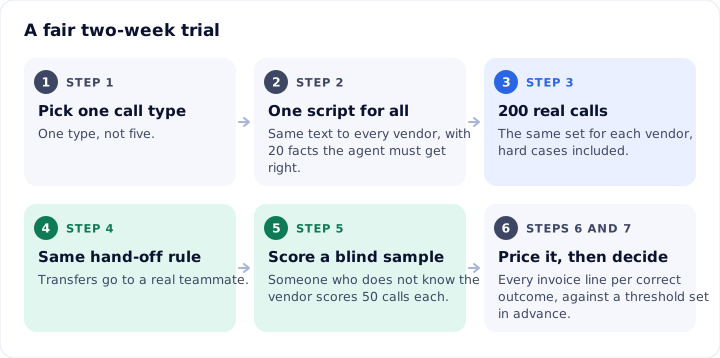
Run a fair two-week trial
Vendor demos use the vendor's best script. A fair trial uses yours.
- Pick one call type. For example appointment confirmations, or inbound after-hours questions. One type, not five.
- Write one script and one knowledge base and give the same text to every vendor. Keep a list of 20 facts the agent must get right.
- Choose 200 real calls or contacts from your own history, the same set for each vendor. Include hard cases: accents, background noise, a caller who interrupts, a caller who wants a person at once.
- Set the same hand-off rule for all of them, such as "transfer on request or after two failed answers", and send transfers to a real teammate.
- Score a blind sample. Have someone who does not know the vendor listen to 50 calls each and score: right answer, right action in your CRM, caller tone, hand-off quality.
- Price the whole call. Add up every invoice line for the trial calls, including the phone line and any transfer minutes, and divide by calls that reached a correct outcome.
- Decide with a threshold written in advance, for example "at least 8 in 10 calls reach the right outcome without a person".
Two vendors is enough. Three is the most you can judge fairly in two weeks. If you are new to this, our beginners guide to building an AI voice bot covers the set-up steps.
When VoiceGenie is the wrong choice
Be skeptical of any vendor, including us. VoiceGenie is likely the wrong choice if your team has engineers who want to own the full stack, if you only need an AI agent and have no live agents to hand calls to, or if you already run a contact-center suite and just want its built-in AI. It is a better fit if you want AI on routine calls and people on the rest in one view; see our page for contact centers and our pricing before you decide.
Common questions
What is the best AI phone calling platform?
There is no single best one. Developers who want full control usually pick a voice API such as Retell, Vapi or Bland. Teams without engineers pick a builder. Large contact centers often extend a suite they already run. Teams that want AI and live agents on one record look at platforms that include a human desk. Match the type to who runs it.
How much do AI phone calls cost per minute?
Published headline rates range from about 5 cents to 14 cents per minute, but several vendors bill the model, voice and phone line on top. Worked from the vendors' own pages in November 2026, all-in cost for common setups lands roughly between 9 and 14 cents per minute before add-ons. Always price a full call, not the headline.
Can an AI phone agent transfer a call to a human?
Yes, most can, but the quality differs. A cold transfer drops the call to a number with no context. A warm transfer lets the person hear a summary first. The best case is a hand-off inside one system, where the agent sees the transcript and what the AI already did. Test this on your own phone numbers.
Do I need a developer to set up an AI calling platform?
For voice APIs, usually yes: you assemble prompts, tools and telephony in code or configuration. Builders and managed platforms aim at non-developers, though complex integrations still need technical help. Ask each vendor who does the set-up, how long it took for a customer like you, and what it costs if you need their team.
Is it legal to use AI voices for outbound calls in the US?
In February 2024 the FCC ruled that AI-generated voices count as artificial voices under the Telephone Consumer Protection Act, so calls need the same prior consent as other artificial-voice calls. State rules and do-not-call lists also apply. This is not legal advice. Ask any vendor how consent, quiet hours and suppression lists are enforced.
Sources
- Retell AI, Pricing, checked 17 Nov 2026
- Vapi, Pricing, checked 17 Nov 2026
- Bland AI, Pricing, checked 17 Nov 2026
- Synthflow, Pricing, checked 17 Nov 2026
- Dialpad, Pricing, checked 17 Nov 2026
- Five9, Pricing, checked 17 Nov 2026
- Talkdesk, Contact center software pricing, checked 17 Nov 2026
- Vapi documentation, Call forwarding and transfer, checked 17 Nov 2026
- Retell AI documentation, Transfer call, checked 17 Nov 2026
- FCC, FCC Makes AI-Generated Voices in Robocalls Illegal (Declaratory Ruling FCC 24-17), 2024
About this post. The rules, prices and figures here were gathered from public sources and were correct to the best of our knowledge on the date shown. They change, and they differ by country and state. This is general information, not legal or financial advice. Before you act, check the latest position with the regulator or company concerned, using the links above. If you spot an error, write to support@voicegenie.ai.
Growth marketing manager at VoiceGenie. Writes about how businesses find, test and measure AI calling.
More posts by Ankita Sachdeva