- Give AI the fast, repeatable calls: sales-line overflow, first calls to consented leads, reminders, notes. Keep discovery, demos and named accounts with reps.
- A B2B SDR costs an estimated $9,500 a month loaded and reaches 4.1 quality conversations a day. Rep time, not AI minutes, is the expensive input.
- Only call people who agreed to be called. An AI voice is an artificial voice under US law, so mobile telemarketing needs written consent.
Who should take which sales calls
Give the AI the fast, repeatable sales calls: answering the sales line, phoning people who asked to be contacted, confirming meetings and logging notes. Keep cold prospecting, discovery, demos, negotiation and named accounts with people. This is a split by call type, not a contest, and it works only for leads who have agreed to be called.
Disclosure: VoiceGenie publishes this post and sells AI calling, so read the numbers with that in mind. We have sourced each one and say where the evidence is thin. A note on terms: most pages for this search describe "AI SDRs" that write email and LinkedIn messages. This one covers the phone. For the full operating picture, see our sales teams page. This post goes deeper on the question a sales leader asks first: what exactly do I hand over?
What a human SDR actually costs and does
Start with the person. The Bridge Group's 2025 survey of 351 B2B companies found a median SDR on-target earnings of $80,000, 40% annual attrition and 3.0 months to ramp a new hire [1]. The nearest BLS category, wholesale and manufacturing sales representatives, had median pay of $76,460 in May 2025 [3]. BLS publishes no separate figure for SDRs.
On-target earnings are not total cost. BLS puts benefits at 30.0% of private-industry compensation [2]. Divide $80,000 by 0.70 and you get about $114,000 a year, or about $9,500 a month, before tools, management and recruiting. That is our estimate, not a published number.
The same survey counted the activity. The median SDR logs 112 activities a day, and teams average 4.1 quality conversations a day. Phone-centric teams average 56 dials for 4.6 of them [1].
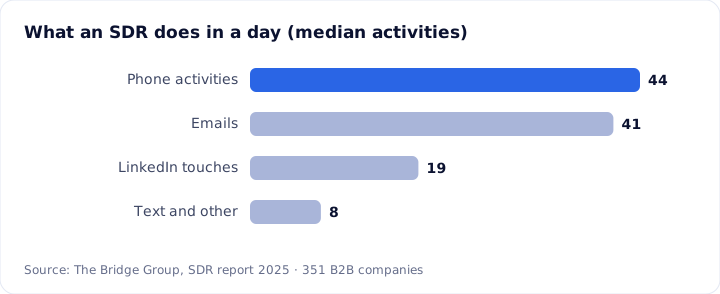
Two other facts matter for the split. Sales professionals say they spend 28% of the week selling and 8.8% keying in data by hand (7,775 respondents, 2022) [5]. And speed is poor at the front door: in a 2013 test of 9,538 companies, 47% never responded to a web inquiry, and those that phoned took a median 3 hours 8 minutes [4]. The test is old and measured response, not sales. Voicemail rarely helps either: Invoca reports that less than 3% of callers pushed to voicemail leave a message [6].
Which calls go to AI and which stay with a rep
Sort calls by what they need. Speed and repetition favor the AI. Judgment, trust and a signature favor a person.
| Call | Who takes it | Why | Guardrail |
|---|---|---|---|
| Sales-line call that rings out or arrives after hours | AI | Under 3% of callers sent to voicemail leave a message [6] | Rep on duty for ready buyers |
| First call to a lead who asked for a demo | AI first, rep joins | Speed is the edge and the questions repeat | Check consent and hours before dialing |
| Meeting confirm, remind, reschedule | AI | Calendar lookup and write-back | Offer a rep for anything else |
| No-show recovery | AI | Short call, interest was real | One retry, then stop |
| Notes and next step after a rep call | AI drafts, rep accepts | Data entry takes 8.8% of the week [5] | Rep reviews before it saves |
| Cold prospecting to target accounts | Rep | No one asked to be called; gatekeepers need judgment | Written consent rules for mobiles |
| Discovery, demos, pricing objections | Rep | Complex deals involve a buying group | AI supplies the prior answers |
| Named accounts, executives, open deals | Rep | The relationship is the asset | Suppress these from AI dialing |
The first four rows are where an AI most plausibly adds capacity, because nobody is working those calls well today. The last three rows are where a bad AI call costs you a deal. If you want the lighter view of this split by lead stage, our voice AI for sales automation guide walks through it, and voice AI cold calling covers the outbound case in depth.
What a hand-off should look like
The point of the split is that the rep never starts cold. When the AI passes a call over, the rep should see a summary, the transcript, the caller's mood and what the AI already did.

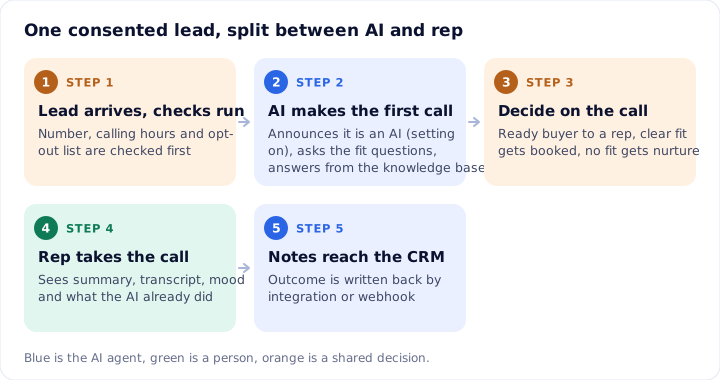
Take the lead who submits a demo form at 4:51 pm. First, the number, the calling hours and the opt-out list are checked. The AI then calls. With the announcement setting on, it says it is an AI, asks four questions the account executives wrote and answers from the knowledge base. On the call it decides: a ready buyer goes to a rep who joins with the answers in hand, a clear fit gets a booked slot, and a poor fit goes to nurture. After the rep call, the outcome reaches the CRM through an integration or a webhook that fires after every attempt.
A worked cost example, and what the person keeps
Take a team with 1,000 consented demo requests and sales-line calls a month. The inputs are planning assumptions, not benchmarks: 3 minutes of AI talk per call, and 5 minutes of rep time per call if a person did it (dialing, talking, notes, one retry).
- AI side: 1,000 calls at 3 minutes is 3,000 minutes at $0.14 per minute, billed per second. You bring your own carrier and numbers, so that cost is yours and sits outside this sum.
- Rep side: 1,000 calls at 5 minutes is about 83 hours. A loaded SDR at $9,500 a month over roughly 168 paid hours costs about $57 an hour, so those 83 hours cost about $4,700 of paid time, before tools and management.
Do not read this as "AI is cheaper, so cut a rep". Those 83 hours are about half of one person's month, and they are the hours a rep would otherwise spend on first calls instead of discovery. The saving is where the time goes.
What the person keeps:
- Every call that needs discovery, a demo, a negotiation or a decision.
- Named accounts, executives and open deals.
- Warm transfers, taken within seconds of a handoff.
- Review of AI calls, which is real work: SaaStr, running five AI sales agents, reports 15 to 20 hours a week of management, self-reported and not a neutral benchmark [11].
- The scripts, the qualification rules and the decision to stop.
A worked example. Move the sliders to match yours.
AI at $0.14 a minute with volume credit applied, plus Insights seats for the people who take handed-over calls. Phone line charges are your carrier's and are not included. Illustration, not a quote. Open the full calculator
The rules before you call anyone (US)
This is general information gathered from public sources. Rules change and differ by state, so check each one on the FCC and FTC sites linked in the sources before you rely on it.
| Rule | What it means for an AI sales call |
|---|---|
| AI voices are artificial voices | The FCC ruled in February 2024 that the TCPA's limits on artificial voices cover AI-generated human voices [8] |
| Written consent for telemarketing to mobiles | Telemarketing to a wireless number with an artificial voice needs prior express written consent [8][9] |
| Business calls and Do Not Call | The FTC says most calls to a business to solicit sales are exempt from the DNC provisions [10]. That does not remove the consent rule for mobiles |
| Calling hours | The federal 8 a.m. to 9 p.m. rule is written for residential lines [9]. States differ, so many teams default to a narrower window |
The practical rule: call people who asked to hear from you. VoiceGenie can set quiet hours, retry limits and do-not-call suppression. It does not announce itself as an AI by default. That is a setting you switch on per agent, and we advise switching it on. The recording notice is not a built-in setting, so write it into the agent's opening line. Surveyed customers are wary: 64% of 5,728 customers surveyed in December 2023 said they would prefer companies not use AI in customer service, mainly fearing they cannot reach a person [7]. Say what the AI is and let people reach a rep.
When to skip the AI, and how to pilot
Skip it for now if:
- Your leads have not agreed to be called and your team lacks written consent records.
- Your qualification rules are not written down. An AI scales what you already do. A team that cannot say what a qualified lead is will get unqualified meetings faster.
- Most of your volume is complex enterprise selling. Little of it is repeatable.
- You only want a pure human dialer, or a text-first AI for email outreach. A narrower tool fits better.
On fit: VoiceGenie covers AI calls and a human desk on one record, and AI agents are billed by usage. Human seats are per-seat licenses. You cannot bring your own AI model. It connects to HubSpot, Salesforce, Zoho and Google calendars, and to other tools through the open API, webhooks or Zapier. VoiceGenie's security program is built to the SOC 2 Type 2, ISO 27001 and ISO 42001 standards, and it handles personal data in line with GDPR. Security documentation is shared on request. Set-up is self-serve, or managed by our team. There is a 14-day trial of the human agent platform and $2 of wallet credit to test AI agents. Pricing is on our pricing page.
A pilot that holds up:
- Baseline (two weeks). Count rung-out calls, voicemails and minutes to first live touch. Agree with your account executives what qualified means.
- After hours only. Forward nights and weekends, with voicemail as fallback. Listen to every call.
- Add overflow and one form source. Name a rep on duty each hour. Time each warm transfer.
- Decide in writing. Compare against the baseline on meetings held and accepted by account executives. Widen, fix or stop.
For definitions of each measure, see our guide to measuring an AI voice bot.
Common questions
Can AI replace SDRs?
Not the whole job. AI can answer the sales line, call people who asked to be contacted, confirm meetings and write notes. It cannot read a buying group or handle a pricing objection. Bridge Group's 2025 survey found AI SDRs were only 1% of respondents [1]. Treat AI as added capacity on specific call types.
Is an AI SDR cheaper than a human SDR?
Per minute of talk, yes. Per outcome, nobody has neutral data. A loaded SDR costs an estimated $9,500 a month before tools and management (our estimate from [1][2]), while AI is billed per minute of calls. Compare cost per held meeting that an account executive accepts, measured in your own pilot, not cost per dial.
Can an AI SDR cold call prospects legally?
It can dial, but the rules limit it. The FCC ruled in 2024 that AI-generated voices are artificial voices under the TCPA, and telemarketing to a mobile number with one needs prior express written consent [8][9]. The FTC exempts most business sales calls from Do Not Call [10], but that does not remove consent. Start with people who asked for contact.
What should a human SDR keep?
Cold prospecting to target accounts, discovery, objection handling, demos, negotiation and named accounts or open deals. Also keep review of the AI's calls and every warm transfer. These calls need judgment or trust, and buyers say they want a person reachable: 64% of surveyed customers prefer no AI in customer service [7].
How do you run a fair AI vs human SDR test?
Pick one call type, such as sales-line calls that ring out, and take a two-week baseline first. Count meetings held and accepted by account executives, not dials or bookings. Review every AI call early, then a sample. Decide in writing to widen, fix or stop. Keep quotas unchanged during the test.
Sources
- The Bridge Group, SDR Models, Motions & Metrics: 2025 Research Report (351 B2B companies)
- U.S. Bureau of Labor Statistics, Employer Costs for Employee Compensation, June 2026
- U.S. Bureau of Labor Statistics, Occupational Outlook Handbook: Wholesale and Manufacturing Sales Representatives (May 2025 pay)
- InsideSales.com (XANT), 2014 Lead Response Report (tests run in 2013)
- Salesforce, State of Sales, 5th edition, 2022 (7,775 sales professionals)
- Invoca, How much missed sales calls cost home services businesses, 2024
- Gartner, Survey finds 64% of customers would prefer companies didn't use AI for customer service, 2024
- FCC, Declaratory Ruling FCC 24-17 on AI-generated voices under the TCPA, 2024
- 47 CFR 64.1200, Delivery restrictions (Cornell Legal Information Institute)
- FTC, Q&A for telemarketers and sellers about DNC provisions in the TSR
- SaaStr, 6 Months of AI SDRs (self-reported by the company running the test)
About this post. The rules, prices and figures here were gathered from public sources and were correct to the best of our knowledge on the date shown. They change, and they differ by country and state. This is general information, not legal or financial advice. Before you act, check the latest position with the regulator or company concerned, using the links above. If you spot an error, write to support@voicegenie.ai.
Founder and Chief Revenue Officer of VoiceGenie. Writes about how sales and customer teams put AI calling to work.
More posts by Maaz Ansari