
- Voice AI fits the steps with a clock and a script: first call to a new lead, fit questions, booking, reminders and re-engagement. Reps keep pricing and named accounts.
- The speed-to-lead studies measure contact and qualification, not closed deals. Use them as direction: a live call in minutes, never silence for hours.
- In the US, an AI voice needs the right consent before it calls a lead. Check consent, local time and do-not-call lists before every outbound call.
Where voice AI fits in a sales process
Voice AI fits the steps of a sales process that run on a clock and a script: the first call to a new lead, a few fit questions, booking the meeting, reminders, no-show recovery, renewal calls and re-engagement. It does not fit pricing talks, negotiation or named accounts. Put the AI where speed and repetition matter, and a rep where judgment does.
Disclosure: VoiceGenie publishes this guide and is one of the vendors in this market. Our lead qualification page covers the product view. This post goes wider: the whole sales process, what the evidence on speed does and does not say, and where we think you should not use a voice agent at all.
The reason to start is the gap on the phone. In a 2013 test sent to 9,538 companies, 47% never responded to a web inquiry, and those that did phone took a median of 3 hours 8 minutes [1]. A 2026 audit of 6,346 company forms found two in three got no email reply [3]. That audit is a vendor's own experiment, and bot filters may have blocked some forms, so read it as a signal. The old study is also old. But the pattern is consistent: demand is paid for, then left waiting.
of 9,538 companies tested never answered a web inquiry; those that phoned took 3 h 8 min at the median (2013 test)1
of 6,346 company forms got no email reply, and 96% of companies never phoned (Clay audit, September 2026)9
higher odds of reaching a lead called at 5 minutes than at 30 (6 companies, 15,000+ leads, 2007 study)2
of businesses asked callers for the sale or appointment, as scored by AI (Invoca, 70M+ calls, 2026)4
Stage by stage: what the AI does and when a rep takes over
A sales process is not one call. It is a sequence, and each stage has a different owner. Sort by what a wrong move costs. If the cost is a slow answer, let the AI go first. If the cost is a discount, a contract term or a relationship, a person decides.
| Stage | The situation | Who leads | Rep takes over when |
|---|---|---|---|
| Inbound call, after hours or overflow | The 7:20 pm call while every rep is busy | AI | Caller is ready to buy now, or asks for a person |
| New web-form lead | A demo request at 4:50 pm | AI calls within minutes | Lead is hot, or is a named account |
| Qualification | Four or five fit questions | AI | Fit is unclear or the deal is multi-site |
| Booking and reminders | Meeting set, confirmed, moved | AI | Lead wants to discuss terms first |
| No-show recovery | Lead missed the demo | AI | Lead wants a different format or a senior contact |
| Quiet leads and re-engagement | Said "not now" on a date you logged | AI calls on that date | Circumstances changed and a deal reopens |
| Renewal and expansion calls | Contract ends in 60 days | AI starts, rep owns | Any price, term or churn-risk signal |
| Price talks, contracts, upset callers | "Can you match this quote?" | Rep | Immediately |
For a fuller sort of nine lead call types by owner, here is the split we use on the lead qualification page.
| Call type | Who takes it | Why |
|---|---|---|
| Inbound sales call, after hours or overflow | AI handles it | Under 3% of callers sent to voicemail leave a message (Invoca). The AI answers, asks the fit questions and books. |
| New web-form lead, first call inside a minute | AI handles it | Speed is the edge here, and the questions are the same every time. Consent, local time and do-not-call checks run first. |
| Pre-sales questions | AI handles it | Answers sit in your knowledge base. Giving them on the first ring keeps the lead warm. Pricing is quoted only as a published range. |
| Meeting confirm, move or reminder | AI handles it | A calendar lookup and a write-back. Reminders protect the held-meeting rate that every booking is judged on. |
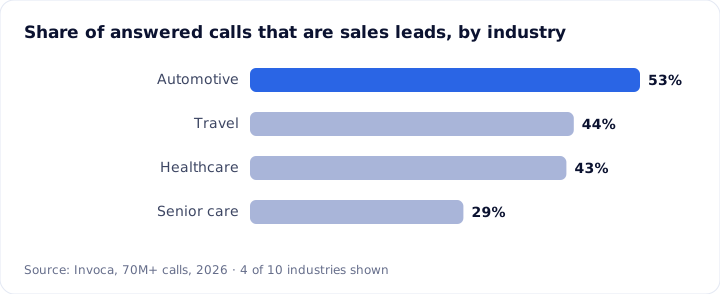
| Not a lead: vendor, applicant, wrong number | AI handles it | Only 29% to 53% of answered calls are leads, by industry (Invoca, 2026). Routing the rest cleanly keeps closers' time for buyers. |
| Ready to buy now | AI, then a person | AI gathers fit and timing in about 90 seconds, then warm-transfers with a summary. If no closer picks up in 20 seconds, it books the next slot. |
| Complex fit: multi-site, custom, partner | AI, then a person | The AI captures company, size, stakeholders and the ask, then routes to the right owner. A person decides if it is worth a custom conversation. |
| Named accounts and executive callers | Straight to a person | The relationship matters more than speed. The AI recognizes the account from the CRM and gets the caller to the account owner. |
| Price talks, contracts, advice, upset callers | Straight to a person | Discounts, legal terms and advice that needs a license call for judgment. A person who asks for a person gets one at once. |
Two notes. First, the AI should never try to close. It gathers fit and timing, then passes the call warm. Second, not every caller is a lead. Invoca's analysis of more than 70 million calls found that 29% to 53% of answered calls, depending on industry, are sales leads [4]. The rest are vendors, existing customers and wrong numbers. Routing them cleanly is half the value.
What the speed-to-lead research says, and what it does not
The most quoted study followed six companies and more than 15,000 web leads. Calling at 5 minutes rather than 30 was linked to about 100 times higher odds of reaching the lead, and about 21 times higher odds of qualifying it [2]. The study states it did not address close ratios [2].
That caveat matters. The data is from 2007, from six firms, and it measures contact. It does not show that a lead called in one minute is worth more revenue than one called in ten. Be wary of the sharper claims in circulation, such as "78% buy from the first responder". We could not trace those to a primary source, so we left them out.
What the evidence does support is simple. Calling within minutes beats calling within hours, and silence for a day is the common failure. Clay's audit found that replies, when they came, tended to arrive the next day [3]. A voice agent that places a call within a minute removes that gap. It does not guarantee a sale.
The lead who filled the form at 9:12 pm
Speed has a legal limit. Federal telemarketing rules bar calls before 8 a.m. or after 9 p.m. at the called party's location [5], and state rules can be tighter. So the 9:12 pm form does not get a night call. Send a confirming text if you hold text consent, and call at 8 a.m. their time. Anyone who promises a call "within 60 seconds, any hour" is ignoring this.
How one lead moves from form to rep
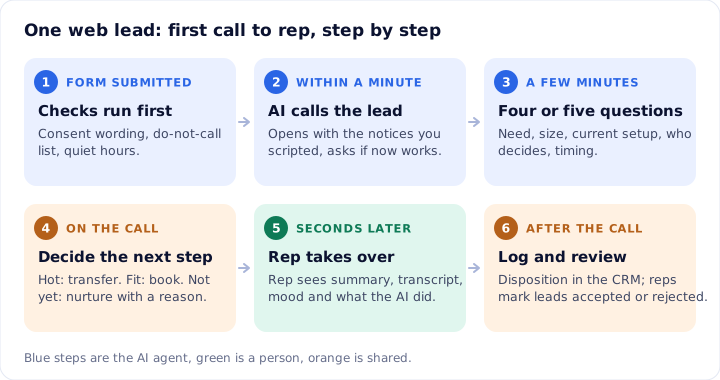
Here is the path of a single web lead. The steps below match the diagram.
- Form submitted, checks run. The system confirms the form carried the consent wording, then checks the do-not-call list and the quiet hours you set.
- The AI calls within a minute. It opens with the notices you scripted and asks if now is a good time.
- Four or five questions. What prompted the request, how big the need is, what they use now, who decides, and when they need it.
- Decide on the call. Hot and urgent: transfer. Clear fit: book. Not yet: tag for nurture with a reason, never delete.
- A rep takes over. The rep sees a summary, the transcript, the lead's mood and what the AI already did, so the lead repeats nothing.
- Log and review. The disposition lands in your CRM. Reps mark each lead accepted or rejected, and the rejections tune the questions.
Ask budget last, as a range, and let the lead skip it. An interrogation that opens with money loses the lead faster than a slow callback does.
What a booking and reminder call sounds like
Reminders protect the held-meeting rate, which is what every booking is judged on. Listen to a short sample.
Hello Daniel, I'm calling from City Care Clinic. You have an appointment with Dr Mehta tomorrow at eleven in the morning. Will you be able to make it, or would you like me to move it to another time?
In English: Hello Daniel, I'm calling from City Care Clinic. You have an appointment with Dr Mehta tomorrow at eleven in the morning. Will you be able to make it, or would you like me to move it to another time?
No-shows, renewals and cold leads: the calls after the first one
Most of the lift in a sales process is not the first call. It is the follow-through that busy reps skip.
No-show recovery. A lead who misses a demo is not lost. A call within the hour, offering a new slot, is a short script with one question. Through your calendar and CRM integrations, the AI can book or move the meeting and update the CRM. If the lead says the timing was never right, it logs the reason and stops.
Renewal and re-engagement. Calling a customer 60 days before a contract ends, or a lead on the date they said "call me in March", is a fixed trigger plus a short script. The AI asks whether anything changed and routes the answer. Any mention of price, a competitor or unhappiness goes to the account owner at once. For more on this pattern, see our guide to automating follow-ups with a voice assistant.
Cold outbound. Calling people who never asked to hear from you is a different job with higher legal risk and lower goodwill. We cover it separately in voice AI for cold calling. The advice here applies to leads who asked, or who are existing customers.
The rules that decide whether you can call at all
This is general information gathered from public sources, for the US. Rules change, so check each one on the regulator's own site, linked in the sources list, before you call.
| Rule | What it means for an AI sales call |
|---|---|
| Written consent | Telemarketing with an artificial voice needs prior express written consent: a signed agreement, e-signature allowed, naming the number and saying signing is not a condition of purchase [5]. The FCC treats AI-generated voices as artificial voices [8] |
| Calling hours | 8 a.m. to 9 p.m. at the called party's location [5]. Default to a narrower window to cover stricter states |
| Opt-outs | A caller may revoke by any reasonable method, and requests must be honored within ten business days at most [5] |
| Inquiry window | A web inquiry gives a three-month window to call, unless the person asks to stop [6] |
| Do-not-call lists | Sync your lists with the national registry at least every 31 days and keep your own list [6] |
VoiceGenie lets you set quiet hours, retry limits and do-not-call suppression. The AI announcement is a setting you switch on per agent. It is not on by default, and we advise switching it on. The recording notice is not a built-in setting. You write it into the agent's opening line.
People are wary, too. In a Gartner survey of 5,728 customers in December 2023, 64% said they would prefer companies not use AI in customer service, and their top worry was reaching a person [7]. The answer is not to hide the AI. Say what it is, answer fast, and hand to a person the moment someone asks.
Cost, and a worked example
Say you get 1,200 leads a month, from calls and web forms, and each AI conversation runs four minutes. That is 4,800 minutes of AI time, billed per second at $0.14 per minute, plus your own carrier charges. Human seats on the Human Agent Desk are a per-seat license, starting at $29 per seat per month on annual billing. Put in your own numbers here:
A worked example. Move the sliders to match yours.
AI at $0.14 a minute with volume credit applied, plus Insights seats for the people who take handed-over calls. Phone line charges are your carrier's and are not included. Illustration, not a quote. Open the full calculator
The calculator treats results as planning figures, not guarantees. The honest comparison is not AI against a rep. It is AI plus reps against the leads you currently miss.
When voice AI is the wrong choice
- Your leads are few and high value. If you work 20 named accounts a quarter, a rep should place every call.
- Your data is not ready. An agent that cannot read your CRM will guess. Fix owner, territory and status fields first.
- Your consent records are weak. If you cannot prove who agreed to be called, wait.
- You want the AI to negotiate. Do not. It gathers, it does not decide.
On fit: VoiceGenie covers AI agents and a human desk on one record, so a hand-off carries the summary and the caller's mood. You bring your own carrier and numbers. Set-up is self-serve, or managed by our team. VoiceGenie's security program is built to the SOC 2 Type 2, ISO 27001 and ISO 42001 standards, and it handles personal data in line with GDPR. Security documentation is shared on request. CRMs connect through HubSpot, Salesforce, Zoho and Google, and other systems through the API and webhooks. If you only need a human dialer, a narrower tool may suit you better. To compare cost with a person, read AI voice agent vs human SDR, and see our pricing page for current rates.
Common questions
What is voice AI for sales?
Voice AI for sales is software that holds real phone conversations with leads and customers. It answers inbound calls, calls new leads, asks qualifying questions, books meetings, and passes hot leads to a rep with notes. It handles the repeatable steps of the process. Reps keep price talks, named accounts and anything that needs judgment.
How fast should a sales team call a new lead?
Aim for a live attempt within minutes, and never leave a form untouched for hours. An older study of about 15,000 leads found that calling at 5 minutes instead of 30 raised the odds of reaching the lead roughly 100 times. It did not measure closed deals, so treat it as direction, not a promise.
Can an AI call a lead who filled out a form?
Yes, with the right consent. In the US, the FCC treats AI-generated voices as artificial voices [8], so telemarketing calls need prior express written consent that names the number. Stay inside legal calling hours at the lead's location, honor opt-outs in any wording, and verify current rules with the official source before launch.
Will voice AI replace our SDRs?
No. It takes the calls that depend on speed and repetition, such as the 7 pm inbound call or the form that arrives while every rep is busy. Your reps spend their time on buyers, pricing, negotiation and named accounts. The goal is more leads answered, with people used where judgment matters.
How much does an AI sales call cost?
AI agents are billed per minute, per second of talk time, at $0.14 per minute, plus your own carrier charges, since you bring your own numbers. A four-minute qualification call is about four minutes of AI time. There is a 14-day trial of the human agent platform and $2 of wallet credit to test AI agents.
Sources
- InsideSales.com (XANT), 2014 Lead Response Report (tests run in 2013)
- Oldroyd with InsideSales.com, The Lead Response Management Study, 2007
- Clay, We asked 6,346 companies for a demo. Most never wrote back, 2026 (a software vendor's own experiment, checked 17 Nov 2026)
- Invoca, Lead Conversion Rate: 2026 Benchmarks From 70M+ Calls
- 47 CFR 64.1200, Delivery restrictions (Cornell Legal Information Institute)
- FTC, Q&A for telemarketers and sellers about DNC provisions in the TSR
- Gartner, survey of 5,728 customers on AI in customer service (press release, 9 Jul 2024)
- FCC, Declaratory Ruling FCC 24-17 on AI-generated voices under the TCPA, 2024
- Clay, We asked 6,346 companies for a demo. Most never wrote back. (2026)
About this post. The rules, prices and figures here were gathered from public sources and were correct to the best of our knowledge on the date shown. They change, and they differ by country and state. This is general information, not legal or financial advice. Before you act, check the latest position with the regulator or company concerned, using the links above. If you spot an error, write to support@voicegenie.ai.
Founder and Chief Revenue Officer of VoiceGenie. Writes about how sales and customer teams put AI calling to work.
More posts by Maaz Ansari