- Automate the follow-ups with a fixed reason to call: missed-call call-back, quote check, post-visit check, no-show rebook. Keep complaints and big quotes with people.
- Call back a missed call within 5 minutes, cap it at 2 calls, and stop on a booking, an answer or any request to stop. Write the stop line into the script.
- An AI voice counts as an artificial voice under US rules, so consent comes first. Telemarketing calls are limited to 8 a.m. to 9 p.m. in the called person's local time.
Which follow-up calls to automate, and how to run them
Automate follow-up calls that have one fixed reason: a missed-call call-back, a quote check, a post-visit check and a no-show rebook. Call within minutes for missed calls, cap attempts at two, and stop on a booking, an answer or any request to stop. Get consent first, call only between 8 a.m. and 9 p.m. local time, and keep a person one request away.
Disclosure: VoiceGenie publishes this guide and sells the tool that makes these calls. The timing and rules below hold with any tool. For the full playbook, see our call follow-up page. This post covers what that page does not: how to set timing, caps and wording so the calls get picked up and do not annoy anyone. Rules cited here are US rules.
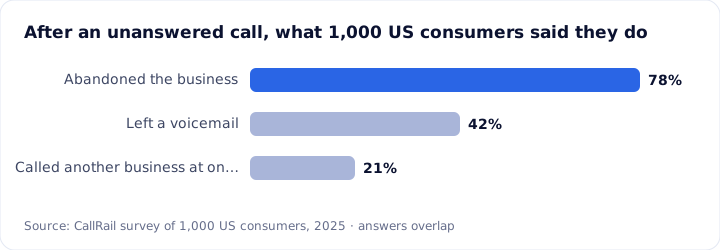
Most follow-up fails because it does not happen. In a 2013 test of 9,538 companies, 47% never answered a web lead, and those that phoned took a median of 3 hours 8 minutes [1]. In a 2024 secret-shopping study of over 100 shops, 62% of open-house visitors got no follow-up after touring [14]. The people who wait do not wait long. In a 2025 survey of 1,000 US consumers, 78% said they had abandoned a business after an unanswered call [2].
The four follow-ups worth automating first
Sort follow-ups by what a wrong move costs. If the worst case is a repeat call or a different time slot, the AI can finish the job. If money or a customer's mood is involved, the AI opens and a person closes.
| Follow-up | Example | Who owns it | Why |
|---|---|---|---|
| Missed-call call-back | The 10:12 am call that rang out | AI | The caller is still shopping and the reason is usually simple |
| Quote follow-up | "Did the estimate reach you?" on day 2 | AI asks, person negotiates | The AI can book the next step; price changes need authority |
| Post-visit check | "Was the job finished? Rate us 1 to 5" | AI | Short, scripted, and a low score opens a same-day task |
| No-show recovery | "We missed you at 2 pm. Thursday at 10?" | AI | The person already wanted the visit; a real open slot recovers it |
| Complaint or refund | "The tech damaged my floor" | Person | They want an apology and a decision, not a survey |
| Large quote or key account | A quote above your threshold | Person | Money and relationship are both at stake |
Quote follow-up is worth the effort. ServiceTitan reported regional median close rates from 31% in the Northeast to 38% in the West for May to July 2026 [4], so a quote that gets no second touch is a lead you paid for and lost. Dormant-lead calls, such as "are you still looking at roof repair?", belong later: they need the strictest consent check.
Timing and attempt limits
Speed matters for the missed call, and patience matters for everything else. There is no published benchmark for the best retry gap or the right cap, so treat the table as a starting point to test against a control group of calls handled the usual way.
| Follow-up | First touch | If no answer | Cap | Stop when |
|---|---|---|---|---|
| Missed call, business hours | Within 5 minutes | One retry about 2 hours later, then a text | 2 calls, 1 text | Answered, booked, or asked to stop |
| Missed call, after hours | First legal window next morning, after 8 a.m. | One retry the same day | 2 calls | Same |
| Quote follow-up | Day 2 after the quote | Day 7, plus a text | 2 calls, 1 text | Quote accepted or declined |
| Post-visit check | 1 to 2 days after the job | Retry next day | 2 calls | Survey done or declined |
| No-show recovery | Within 2 hours of the missed slot | Retry next morning | 2 calls | Rebooked or declined |
| Dormant lead, 90+ days | One call in a set window | None | 1 call | Any answer |
Planning defaults, not benchmarks. Count your own results for a week before you fix them.
Two limits are not a choice. Federal rules bar telephone solicitations before 8 a.m. or after 9 p.m. at the called person's location [5]. The rules differ in scope, so check which apply to your calls. Some states are tighter: Oklahoma caps solicitation calls at 3 per 24 hours even with consent, with exemptions, and Washington and Oklahoma bar them after 8 pm [11]. Those two states' rules are from a 2022 law-firm summary, so check the current text.
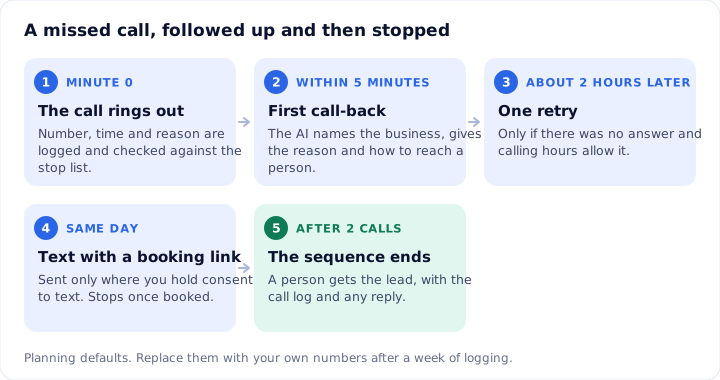
The ladder ends on purpose. A third call to someone who ignored two is not persistence, it is the reason they block your number. On VoiceGenie you can set quiet hours, retry limits and do-not-call suppression on the campaign, and an API call removes a contact from a multi-step sequence the moment they book elsewhere.
Text or call?
Call first for a missed call, since the person wanted a conversation. But 86% of calls from unknown numbers go unanswered in Hiya's 2026 data, across 12,000+ consumers in 6 countries [3], so expect the first call to ring out often. A short text with a booking link after the unanswered attempt gives the person a way to answer on their own terms. Text only numbers where you hold consent to text.
What the call should say
A good follow-up call does five things in under two minutes: names the business, says it is an AI, gives the reason, asks one question, and tells the person how to stop. On VoiceGenie the AI announcement is a setting you switch on per agent, and the recording notice is written into the agent's opening line. Turn the announcement on.
Here is a missed-call call-back that books an estimate:
AI: Hi, this is an AI assistant from Northline Heating and Air, returning your call from 10:12. This call is recorded. Am I speaking with Dana?
Caller: Yes. I wanted a price on a new furnace.
AI: I can set that up. What is the street address for the estimate? You can say "stop" at any time to end these calls, or ask for a person.
Caller: 48 Linden Road.
AI: Thursday between 2 and 4 pm is open. I will text a confirmation with the estimator's name. Does that work?
Hear how a short scripted reminder sounds with an AI voice:
Hello Daniel, I'm calling from City Care Clinic. You have an appointment with Dr Mehta tomorrow at eleven in the morning. Will you be able to make it, or would you like me to move it to another time?
In English: Hello Daniel, I'm calling from City Care Clinic. You have an appointment with Dr Mehta tomorrow at eleven in the morning. Will you be able to make it, or would you like me to move it to another time?
Rules for the script:
- One reason, one question. "Returning your call" and "Did the quote arrive?" beat a pitch.
- Confirm the person. If someone else answers, say nothing about the reason and end the call politely.
- Say how to stop. The FCC is moving toward letting callers name the opt-out method, such as a spoken or key-press opt-out, if it is disclosed on the call [9][10]. Naming it up front protects you either way.
- Leave a short voicemail or none. No account details, no amounts. Give the business name and a call-back number.
- Hand off with context. When the caller asks for a person, the human sees a summary, the transcript, the caller's mood and what the AI already did. The caller should not repeat the story.
Stop rules and consent
This section is general information gathered from public sources, not advice. Check each rule on the FCC, FTC or state regulator's own site before you rely on it.
An AI-generated voice is an artificial voice under the TCPA, per the FCC's 2024 ruling [6]. Calls to cell phones with one need prior express consent, and calls that advertise need prior express written consent [5]. Whether a customer's missed call to you counts as consent for an AI call-back is a question to settle with the official source. The safe route is to capture consent in the phone menu or on the form where the number was given.
| Call type | Consent to plan for | Watch for |
|---|---|---|
| Call-back to a person who just called | Prior express consent for an AI voice; capture it at the IVR or form | Keep to the reason they called about |
| Quote or visit follow-up | Prior express consent; keep the record | Do not add a sales pitch to a service call |
| Re-engaging an old lead | Written consent if the call is marketing | Under the FTC's do-not-call rule an inquiry gives 3 months and a purchase 18 months, but that does not replace consent for an artificial voice [7] |
| Any number collected months ago | Check it was not reassigned | Run the FCC Reassigned Numbers Database check first [8] |
Stop rules are the part teams get wrong. A request to stop, by any reasonable method, must be honored within a reasonable time that does not exceed 10 business days, and an internal do-not-call request is kept for 5 years [5]. Do it the same day anyway, across the AI and your staff. In early October 2026 the FCC released new revocation rules (FCC 26-67): a stop in reply to an informational call can be limited to that category, a stop on marketing still ends all marketing, and callers may designate an opt-out method if they disclose it on the call [9][10]. Law-firm summaries give different dates for adoption and for taking effect, so read the order itself.
Recording laws also vary. Federal law needs one party's consent, and 13 states need all parties, per a 2024 summary [12]. Say "this call is recorded" first.
Run one list for eight weeks, then decide
Do not switch on all four follow-ups at once. Pick missed calls in business hours.
Week 1. Log every missed call: time, who called back, how long it took. Write the script. Load the stop list, quiet hours and a cap of 2 calls. Name who takes hand-offs.
Weeks 2 to 3. Run weekdays 10 am to 3 pm. A person listens to every call the same day. Send every fourth missed call to staff as usual, as the control.
Weeks 4 to 6. Open all business hours. Review 20 random calls a week and every hand-off.
Weeks 7 to 8. Compare with the control. If it holds, add quote follow-up on day 2 and day 7.
Measure outcomes, not calls placed:
| Measure | How to count it |
|---|---|
| Time to first call-back | Minutes from missed call end to first attempt; median and 90th percentile |
| Right-party contact | Call-backs answered by the person who called, divided by call-backs attempted |
| Outcome rate | Connected call-backs that end in a booking or a resolved question |
| Hand-off without repeating | Reviewed hand-offs where the caller did not restate the reason |
| Stop requests honored | Stops suppressed everywhere the same day, from dialer logs |
Invoca reports that 42% of phone leads convert on the call [13], but those are live inbound leads. A call-back is a colder contact, so set your own target. For definitions, see our guide to measuring an AI voice bot. A two-minute call costs two minutes at $0.14 a minute, billed per second. You bring your own carrier and numbers. Try your own volumes here:
A worked example. Move the sliders to match yours.
AI at $0.14 a minute with volume credit applied, plus Insights seats for the people who take handed-over calls. Phone line charges are your carrier's and are not included. Illustration, not a quote. Open the full calculator

When not to automate a follow-up
- The person is upset. A survey call to someone with an open complaint makes it worse. Pull them out of every campaign.
- You have no consent record. If you cannot show where the number came from, do not call with an AI voice.
- The quote is large. A person calls first. The AI can book the time.
- Your calendar is not connected. An agent that cannot see open slots will guess. Fix that first.
- You want more calls, not better ones. Volume does not fix a weak offer.
VoiceGenie runs AI calls and a human desk on one record, and the AI can start a call by API, and post-call webhooks or Zapier send the full conversation record back to your CRM. It suits teams that want both. If you only need a text reminder, a simpler tool is cheaper. VoiceGenie's security program is built to the SOC 2 Type 2, ISO 27001 and ISO 42001 standards, and it handles personal data in line with GDPR. Security documentation is shared on request. For wider context, read our guides to automated phone calls for business and the mistakes to avoid when setting up an AI caller. Pricing is on our pricing page.
Common questions
How many times should you follow up automatically?
For a missed call, two calls and one text is a sensible cap. For a quote, two calls, about day 2 and day 7. For a post-visit check, one call and one retry. These are planning defaults, not measured benchmarks. Cap per contact, not per campaign, and stop at once on a booking, an answer or a stop request.
How fast should you call back a missed call?
Within 5 minutes is a sound target. A 2013 test of 9,538 companies found a median phone reply of 3 hours 8 minutes to a web lead, and 47% never replied [1]. The caller who just rang is still shopping, and 21% of surveyed consumers call another business at once [2].
Can an AI make automated follow-up calls legally in the US?
Yes, with consent. The FCC ruled in 2024 that AI-generated voices are artificial voices under the TCPA, so calls to cell phones need prior express consent, and marketing calls need written consent [6]. Honor stop requests within 10 business days at most, and keep solicitation calls to 8 a.m. to 9 p.m. local time [5]. Check the rules with the official source.
Should a missed call get a text or a call back?
Do both in order. Call first, because the caller wanted to talk and 86% of calls from unknown numbers go unanswered, so your call may not be picked up [3]. Follow an unanswered call with a short text that has a booking link, but only where you hold consent to text that number.
What should an automated follow-up call say?
Name the business, say it is an AI if you have that setting on, state the reason for the call in one sentence, ask one question, and tell the person how to stop calls or reach a human. Keep it under two minutes. End the call early whenever the person asks to stop or to talk to someone.
Sources
- XANT (InsideSales.com), 2014 Lead Response Report: 14,061 companies tested in 2013, 9,538 analyzed
- CallRail, Missed calls cost businesses more than ever (survey of 1,000 US consumers), 2025
- Hiya, State of the Call 2026
- ServiceTitan, State of the Trades: quarterly industry trends, 2026
- 47 CFR 64.1200, Delivery restrictions (eCFR text via Cornell LII)
- FCC, Declaratory Ruling FCC 24-17 on AI-generated voices under the TCPA, 2024
- FTC, Q&A for telemarketers and sellers about DNC provisions in the TSR
- FCC, Reassigned Numbers Database
- FCC, Fact sheet on TCPA consent revocation rules, 9 Sept 2026
- Nixon Peabody, FCC scraps revoke-all and lets businesses pick how consumers opt out, 7 Oct 2026
- Manatt, Phelps & Phillips, Washington's and Oklahoma's new telemarketing laws, 2022
- King & Spalding, Wiretap laws in the United States, 2024
- Invoca, Lead conversion rate benchmarks, 2026
- Mike DelPrete, Secret shopping: 47% of online property inquiries are ignored, 2024
About this post. The rules, prices and figures here were gathered from public sources and were correct to the best of our knowledge on the date shown. They change, and they differ by country and state. This is general information, not legal or financial advice. Before you act, check the latest position with the regulator or company concerned, using the links above. If you spot an error, write to support@voicegenie.ai.
Content marketing associate at VoiceGenie. Writes guides on setting up and running AI voice agents.
More posts by Rohit Singh