
- Four kinds of automated call exist: recorded broadcast, keypad IVR, auto-dialer and conversational AI. Only the last holds a real conversation.
- Automate calls with a clear goal and a short script (reminders, hours, booking). Keep disputes, distress and large decisions with people.
- Inbound calls carry few legal limits. Outbound calls need consent, calling-hour limits and opt-out handling, and AI voices count as artificial voices in the US.
What are automated phone calls, and which kind do you need?
Automated phone calls are calls placed or answered by software instead of a person. There are four kinds: recorded broadcasts, keypad menus (IVR), auto-dialers, and conversational AI agents. Pick by the job. A one-way notice needs a recording. A call that must listen, answer and book needs an AI agent, and a person should still take the hard ones.
VoiceGenie publishes this guide and sells one of the options, so weigh our view with that in mind. Where another approach fits better, we say so.
| Type | What it does | Good for | Weak at |
|---|---|---|---|
| Recorded broadcast | Plays one message to a list | Closures, outage notices | Anything needing a reply |
| Keypad IVR (inbound) | Plays a menu, reads keypad presses | Routing to 3 to 5 departments | Callers whose problem fits no option |
| Auto-dialer | Dials a list and connects answered calls to a person | Teams with many agents and long lists | It still needs people on every call |
| Conversational AI agent | Speaks, listens, answers, books, hands off | Reminders, booking, after-hours, first-line questions | Angry, high-stakes or unusual calls |
Most real setups mix them. An IVR may route to an AI agent, and an AI agent may hand off to a person. For the menu versus conversation question in depth, see conversational voice AI vs IVR.
Why businesses automate calls
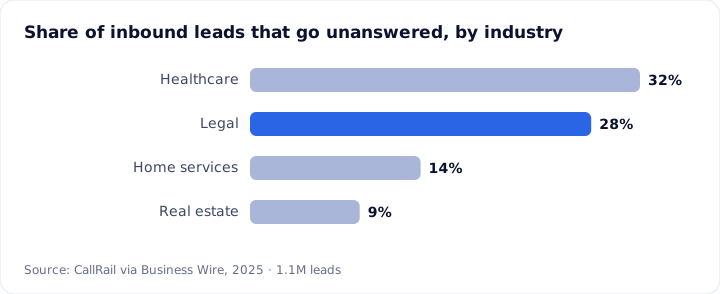
The case rests on missed calls more than on savings. In a CallRail survey of 1,000 US consumers, 78% said they had abandoned a business after an unanswered call [11]. The share of unanswered leads varies a lot by trade. CallRail's 2025 benchmark of 1.1 million leads found 32% missed in healthcare and 9% in real estate [10].
Automation answers on the first ring, at 9:12 pm, during lunch and on the busiest Monday. It does not remove the need for staff. It keeps routine calls from crowding out the calls that need one.
Customers are cautious. Gartner found 64% of 5,728 customers would prefer companies not use AI in customer service, mostly because they fear it will be harder to reach a person [12]. The design answer is simple: make the person easy to reach.
Which of your calls to automate, and which to keep
Sort calls by stakes and by how much judgment the answer needs, not by topic. Tag your top ten call reasons for two weeks, then place each one here.
| Call | Example | Verdict |
|---|---|---|
| Hours, address, prices | "Are you open Saturday?" | Automate |
| Appointment reminders and confirmations | Tomorrow 3 pm, reply to confirm | Automate |
| Booking and rescheduling | Find a slot, update the calendar | Automate, with a person as backup |
| Order or ticket status | "Where is my order?" | Automate |
| New lead who just filled a form | Called within a minute, asks two questions | Hybrid: AI qualifies, person closes |
| Payment reminder | Invoice 5 days overdue | Hybrid: AI reminds, person handles disputes |
| Complaint or cancellation threat | "I want to speak to a manager" | Keep human |
| Medical emergency or safety issue | Chest pain, gas smell | Keep human, route at once |
| Large or legal decisions | Contract changes, claims | Keep human |
The rule of thumb: automate the call when the answer is the same whoever asks, and when a wrong answer is cheap to fix. Mistakes at launch tend to be about scope, so read mistakes to avoid when setting up an AI caller before you write the first script.
Hello Daniel, I'm calling from City Care Clinic. You have an appointment with Dr Mehta tomorrow at eleven in the morning. Will you be able to make it, or would you like me to move it to another time?
In English: Hello Daniel, I'm calling from City Care Clinic. You have an appointment with Dr Mehta tomorrow at eleven in the morning. Will you be able to make it, or would you like me to move it to another time?
Inbound or outbound: how each works
Inbound means customers call you. The call reaches your number, and the system answers when staff are busy, closed or absent. You can put automation behind an existing menu option, after a set number of rings, or only after hours, without changing your phone system. A good inbound flow says what it is, answers from approved information, takes an action, and offers a person.
Outbound means you call them. Common jobs are appointment reminders, payment reminders, renewal notices, delivery updates and feedback calls. Outbound is where the law bites, because you start the call. It also needs pacing, retry limits and a way to stop when someone says stop.
The two meet in a hand-off. If the caller asks for a person, or the agent is unsure, the call moves to a human with the summary and transcript so nobody repeats themselves. A call that cannot reach a person is the main reason customers dislike automation.

New to the underlying technology? What is an AI voice agent explains the parts.
What automated calls cost
You pay for three things: the phone line, the software, and the conversation.
The line. Published US carrier rates are low. Twilio lists local inbound at $0.0085 a minute, outbound at $0.0140 and a local number at $1.15 a month [8]. Plivo lists $0.0055 inbound, $0.0115 outbound and $0.50 a month [9]. Both pages were checked on 17 Nov 2026.
The conversation. VoiceGenie bills AI calls at $0.14 a minute, by the second, and does not sell or bill the phone line: you bring your own carrier and numbers. Human seats are a per-person license if you want people on the same system: $29 a month for the desk. See pricing.
A worked example. A clinic gets 600 calls a month and the AI handles 3 minutes of each on average. That is 1,800 minutes. The AI charge is 1,800 times the per-minute rate. The inbound line, at the Twilio rate, is 1,800 times $0.0085, about $15, plus a $1.15 number. The line is a rounding error. The AI minutes are the real cost, and they scale with talk time, so short, tight scripts save money.
For context, BLS reports a median receptionist wage of $38,010 a year [13]. That is wages only, for one person working set hours. The comparison is not "AI or receptionist". It is the calls your receptionist cannot reach, at 7 pm, at lunch, or while on another line.
What the law requires
This section was gathered from public sources and is general information, not legal advice. Rules change and differ by state and country, so confirm the current position on the regulator's own site, linked in the sources, before you start calling.
United States
- AI voices are artificial voices. In February 2024 the FCC ruled that the TCPA's "artificial or prerecorded voice" rules cover current AI technologies that resemble human voices. Such calls need the called person's prior express consent, and written consent if the call includes marketing [1].
- Penalties are per call. The statute allows $500 per violation, up to three times that if willful [2].
- Consent matters most for outbound. Calls the customer starts, such as an inbound after-hours call, avoid the consent question. Outbound reminders to a customer who gave their number for that purpose are different from cold calls to a purchased list.
- Prerecorded sales calls need a signed written agreement from the person, which cannot be a condition of purchase [3][4].
- Calling hours. Telemarketing calls without consent may not be made before 8 a.m. or after 9 p.m. at the called person's location [3]. Some states set shorter windows, so check each state you call.
- Do Not Call. Sync with the national registry at least every 31 days. A business relationship lets you call for 18 months after a purchase and 3 months after an inquiry, and you must stop when someone asks [4].
- Dialer pacing. The FTC allows no more than 3% abandoned calls, meaning answered calls with no one ready to talk [3].
- Recording. Some states require everyone on the call to consent to recording. Say it is recorded at the start.
UK and India, briefly
In the UK, an automated marketing call needs the person's specific consent, general consent does not cover it, and the call must name you and give contact details [5]. Live marketing calls must be screened against the TPS and CTPS registers [5]. India differs by call type. TRAI says promotional calls come from the 140 series and transactional or service calls from 1600, and ordinary 10-digit numbers can no longer be used for telemarketing [6]. TRAI also runs a preference register that lets people block promotional calls, so check its current rules on consent and calling hours before any promotional campaign.
How to start with one call type
Do not automate the whole phone line. Pick one call, run it for a month, then expand.
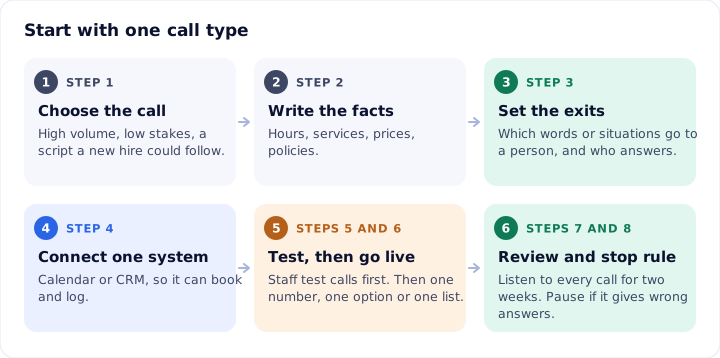
- Choose the call. Pick high volume, low stakes and a script a new hire could follow: after-hours questions, or appointment reminders.
- Write the facts. List hours, services, prices and policies. The agent can only answer from what you give it.
- Set the exits. Decide which words or situations route to a person, and who answers.
- Connect one system. Link your calendar or CRM so it can book and log, not just talk.
- Test with staff. Call it ten times with awkward questions and bad connections.
- Go live narrowly. One number, one option, or one outbound list. For outbound, load only people with consent on file.
- Review every call for two weeks. Listen to recordings. Fix gaps in the knowledge, not in the voice.
- Set a stop rule. Pause if callers keep asking for a person or give wrong information. Expand only when it holds.
To judge results, see how to measure your AI voice bot. If your use is a front desk, the AI receptionist page lays out the same plan for that case.
When VoiceGenie is not the right choice
If you only need a one-way recorded notice, a broadcast tool is simpler and cheaper. If your calls are mostly emotional or complex, invest in people and better scheduling first. If you want a single-purpose answering service with humans only, a human service may serve you better. VoiceGenie suits teams that want AI to answer or place routine calls and a person to take the rest on the same record, with their own carrier and numbers.
Common questions
Are automated phone calls legal?
Yes, with conditions. In the US, calls using an artificial or prerecorded voice generally need the called person's prior express consent, and written consent if the call is marketing. You must also honor Do Not Call requests and calling hours. Inbound automation, where customers call you, faces far fewer limits. UK and India add their own consent and registry rules.
Do I have to tell people they are talking to an AI?
No single US federal rule requires it today, but some states have disclosure laws, and recording laws may require a notice anyway. The safest practice is to say it is an AI in the first sentence of every call, inbound or outbound. It also builds trust.
How much do automated phone calls cost?
Three costs apply: the phone line, the software, and any per-minute AI charge. US carrier rates are about one to two cents a minute and about a dollar a month per number. Conversational AI is billed per minute on top. A small business answering a few hundred calls a month can plan a monthly bill in the low hundreds of dollars.
What is the difference between an IVR and an AI voice agent?
An IVR plays a menu and listens for keypad presses or a few set words, so callers must fit their problem into the menu. An AI voice agent understands ordinary speech, answers questions, takes actions such as booking, and can change course mid-call. IVRs suit a handful of fixed choices. Agents suit open-ended calls.
Which calls should I not automate?
Keep a person on calls where the caller is upset, frightened or in a dispute, calls about large sums or legal risk, medical emergencies, and any call where a wrong answer is costly. Automate the routine ones around them: hours, status checks, reminders and booking. Always give callers a quick way to reach a person.
Sources
- FCC, Declaratory Ruling FCC 24-17 on AI-generated voices under the TCPA, 2024
- 47 U.S.C. 227, Restrictions on use of telephone equipment (Cornell LII)
- 16 CFR 310.4, Telemarketing Sales Rule, abusive practices (Cornell LII)
- FTC, Q&A for telemarketers and sellers about DNC provisions in the TSR
- ICO (UK), Telephone marketing under PECR
- TRAI (India), Press release No. 11 of 2025 on spam and telemarketing amendments
- Twilio, US voice pricing, checked 17 Nov 2026
- Plivo, US voice API pricing, checked 17 Nov 2026
- CallRail via Business Wire, small business benchmark report (1.1 million leads), 2025
- CallRail, Why businesses can't afford to miss calls (1,000 US consumers), 2025
- Gartner, 64% of customers would prefer companies not use AI for customer service, 2024
- US Bureau of Labor Statistics, Receptionists, Occupational Outlook Handbook, 2025
About this post. The rules, prices and figures here were gathered from public sources and were correct to the best of our knowledge on the date shown. They change, and they differ by country and state. This is general information, not legal or financial advice. Before you act, check the latest position with the regulator or company concerned, using the links above. If you spot an error, write to support@voicegenie.ai.
Content marketing associate at VoiceGenie. Writes guides on setting up and running AI voice agents.
More posts by Rohit Singh