
- Natural is mostly timing and detail: a short pause, no talking over the caller, one idea per turn, and numbers, dates and names read the way people say them.
- Test each language with a native speaker. Check the politeness form, mixed-language speech and accents, not only whether the words are right.
- Do not pretend to be human. Switch on the AI announcement and write a friendly opening line. Callers forgive a bot, not a trick.
What makes an AI voice agent sound natural
An AI voice agent sounds natural when it answers after a short, steady pause, stops when the caller speaks, keeps each turn to one idea, reads numbers and names the way people say them, and uses the right form of address for the language. The voice itself matters less than these habits. It should also say it is an AI.
Disclosure: VoiceGenie publishes this guide and sells an AI voice agent. The advice holds on any platform, and the last section says where our product is not the right fit. If you are still choosing a platform, our guide to AI phone calling platforms compares the options.
The tests below use real call moments, not a demo script. A caller who says "hello?" twice, a card number read as one long digit string, and a name pronounced wrong in the first ten seconds each tell the caller what they are talking to before the agent says a word.
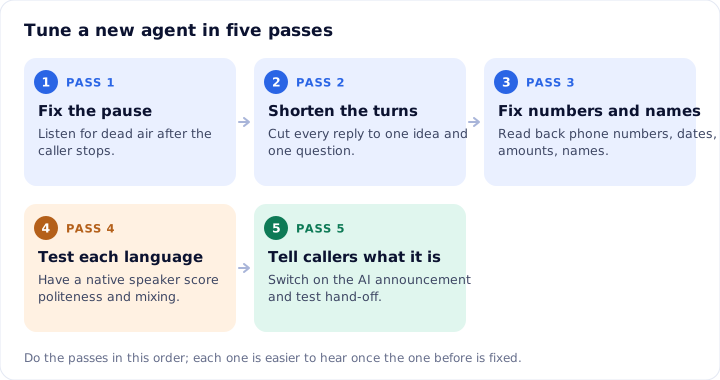
Pass 1: Fix the pause and the interruptions
Silence is the first thing a caller notices. People take turns fast. A study of ten languages found that gaps between turns differ by language, but within a narrow range of 250 ms of the cross-language average, and that every language avoids overlap and keeps silence short [1]. Callers are used to that rhythm, so a machine that breaks it stands out.
Two numbers help you think about delay. The telecom standard ITU-T G.114 says that below 150 ms of one-way delay most applications, speech included, see essentially transparent interactivity, and it recommends not exceeding 400 ms for general network planning [2]. That figure covers the network only. Your agent adds listening, thinking and speaking time on top, so every extra second of processing is felt.
What to do:
- Listen to real recordings, not a test in a quiet room. Find the three longest pauses in a day of calls and fix those first.
- Cover a slow lookup with a short phrase. "Let me check that" before a calendar or CRM lookup is honest and takes a second. A string of "um" and "hmm" is not.
- Handle interruptions both ways. When the caller starts talking, the agent should stop within a word or two and listen. When the caller only says "mm-hm" or "okay," it should keep going. Test both.
- Do not cut in on a pause. A caller reading out an account number stops between groups of digits. The agent should wait.
Pass 2: Keep turns short
Long answers are the second giveaway. People speak in a sentence or two and then pass the turn. An agent that delivers a paragraph sounds like a recording, and callers talk over it.
A useful rule: one idea and at most one question per turn. Compare:
- Long: "Thank you for calling. I can help you with appointments, billing questions, and account changes, and I can also give you hours and directions. What would you like to do today?"
- Short: "Hi, this is the AI assistant at Greenfield Dental. Are you calling about an appointment?"
Write replies for the ear. Use contractions. Avoid lists of more than three items. Vary the wording of acknowledgments so the agent does not say "Great, thanks for that" nine times in one call. Give it a tone that fits your business, formal for a bank and relaxed for a pizza shop, and keep humor out unless your brand already uses it.
Pass 3: Say numbers, dates, names and amounts the way people do
This is where most agents give themselves away, and where most teams do not look. Check each item below against real calls.
| Detail | What sounds wrong | What sounds right |
|---|---|---|
| Phone numbers | "Five five five one two one two" in one run | Groups with a beat between them, then a read-back to confirm |
| Dates | "Eleven twelve" with no month named | "Thursday, November 12" in the caller's own order of day and month |
| Times and time zones | "Fourteen hundred" to a US caller | "Two p.m. Eastern", matched to the local custom |
| Amounts | "One thousand two hundred fifty point zero zero" | "Twelve fifty" or "twelve hundred fifty dollars" |
| Names | A guessed pronunciation, used four times | Ask once: "Did I say your name right?" Then use it sparingly |
| Order and reference numbers | A 12-digit string read fast | Short chunks, offered as a text or email instead |
Two habits fix most of these. First, read back anything the caller will act on: the appointment time, the amount, the callback number. VoiceGenie agents can confirm names, dates and amounts by reading them back, and you control the wording. Second, offer to text anything long. A confirmation by SMS beats a 12-digit code read aloud, and it works for callers who are driving or on a noisy line.
Date order is the quiet trap. "3/4" is March 4 in the US and 3 April in the UK and India. Say the month by name.
Pass 4: Test each language, form of address and accent
Natural speech is not the same in every language. "Same words, translated" is the common mistake. Three things change.
Politeness forms
Many languages choose a form of "you" by relationship. Hindi has aap, tum and tu. Spanish has usted and tú. French has vous and tu, and German has Sie and du. Japanese has layers of formal speech. A bank agent that says tum to an older customer in Hindi, or tú to a stranger in Mexican Spanish, sounds rude even if every word is correct. Default to the formal form for first calls and for anything about money, and switch only if your brand and market clearly call for it.
Code-mixing
In much of India, and among Spanish and English speakers in the US, people mix two languages inside one sentence, such as Hindi with English words for "payment," "EMI" and "appointment." A script written in pure formal Hindi can sound stiffer than a call center agent would. The Census of India lists 270 mother tongues with 10,000 or more speakers each and 22 scheduled languages, with Hindi the mother tongue of 43.63% of people [6], so "Hindi" alone is a coarse label. Let the agent use the English loan words your callers use, and test how it handles a caller who changes language halfway.
Accents
Speech recognition does better on some accents and noise conditions than others, and the gap is not the same for every language or model. We do not publish an accuracy figure here because we have not verified one that fits your callers. Do this instead: gather 20 calls from the regions you serve, read the transcripts, list the words the agent keeps mishearing (place names, product names, surnames), and add them to the agent's knowledge base or spelling hints.
VoiceGenie supports 90+ languages, so the list of languages is not the limit. The quality of your test is. See our language page for what is available, then listen to these samples.
Hello Daniel, I'm calling from City Care Clinic. You have an appointment with Dr Mehta tomorrow at eleven in the morning. Will you be able to make it, or would you like me to move it to another time?
In English: Hello Daniel, I'm calling from City Care Clinic. You have an appointment with Dr Mehta tomorrow at eleven in the morning. Will you be able to make it, or would you like me to move it to another time?
नमस्ते, क्या मेरी बात अंजलि जी से हो रही है? जी, मैं सुविधा फ़ाइनेंस से बोल रही हूँ। आपकी इस महीने की EMI पाँच तारीख़ को due है। क्या मैं payment link SMS पर भेज दूँ?
In English: Hello, am I speaking with Anjali ji? I am calling from Suvidha Finance. Your EMI for this month is due on the fifth. Shall I send the payment link by SMS?
Buenas tardes, le llamo de Tienda Fácil para confirmar su pedido. Podemos entregarlo mañana entre las nueve y las doce, o entre las dos y las cinco de la tarde. ¿Cuál horario le queda mejor?
In English: Good afternoon, I am calling from Tienda Fácil to confirm your order. We can deliver it tomorrow between nine and twelve, or between two and five in the afternoon. Which time suits you better?
Listen for the opening, the form of address, and how each reads the amount or date. Ask a native speaker, not a colleague who is fluent.
Pass 5: Be honest that it is an AI
Do not try to pass as a person. It fails in two ways. Callers notice anyway, and then they trust everything else the agent says less. And the law is moving toward disclosure. The EU AI Act asks that systems built to interact with people tell them so, at the latest at first interaction, from 2 August 2026 [4]. California makes it unlawful to use a bot to communicate online with someone in California with intent to mislead them about its artificial identity in order to push a sale or sway a vote, unless the bot discloses it is a bot; the statute speaks of "online" use, so check how it applies to voice calls [5]. In the US, the FCC ruled in 2024 that AI-generated voices are "artificial" voices under the TCPA, so the consent rules for such calls apply [3]. This is general information gathered from public sources, not a full list of rules. Check the regulator's own site for your country and call type before you launch.
The good news is that a disclosure does not have to be cold. "Hi, this is Maya, an AI assistant for Greenfield Dental, calling about your appointment tomorrow. Is now a good time?" is clear, short and friendly.
On VoiceGenie, the AI announcement is a setting you switch on per agent. It is not on by default, so turn it on. If you record calls, the recording notice is written into the agent's opening line.
Honesty also covers what the agent does not know. When it cannot answer, it should say so and offer a person or a callback, not guess. A hand-off should carry context: the person sees a summary, the transcript, the caller's mood and what the AI already did, so the caller does not repeat themselves. For more on the ethics, read ethical considerations of using voice bots.
How to check the work, and when VoiceGenie is not the fit
Run each pass on 20 to 30 real calls, with a checklist: pause too long, talked over the caller, turn too long, number misread, wrong form of address, mispronounced name, unclear it was an AI. Count each. Fix the most frequent first, then listen again. For outcome measures such as resolution and hand-off quality, see how to measure the success of your AI voice bot, and for common setup errors read mistakes to avoid when setting up an AI caller.
You can try this on VoiceGenie with a 14-day trial of the human agent platform and $2 of wallet credit to test AI agents. AI agents are usage based, at $0.14 per minute billed per second, and human agents are a per-seat license. You bring your own carrier and numbers. Setup is self-serve, or our team can set up and maintain the agents. Details are on the pricing page, and an example of a first call type to tune is on our payment reminders page.
VoiceGenie is the wrong choice in these cases:
- You need a custom voice model of your own, since customers cannot bring their own AI model.
- Your security review needs specific evidence. VoiceGenie's security program is built to the SOC 2 Type 2, ISO 27001 and ISO 42001 standards, and it handles personal data in line with GDPR. Security documentation is shared on request.
- Your callers mostly need a person and an IVR would do. A narrower tool may suit you better.
Common questions
How long should an AI voice agent pause before answering?
Short enough that the caller does not say hello twice, long enough that it does not cut in on a mid-sentence breath. In human conversation the gap between turns is brief and varies little across languages [1]. Measure the silence in real recordings, and fix the longest pauses first, since those are what callers notice.
Should an AI voice agent say it is an AI?
Yes. It is honest, it sets expectations, and the rules are moving that way. The EU AI Act expects systems that talk to people to say so at first interaction [4], and California bars online bots that mislead people about being artificial to push a sale, unless the bot discloses it [5]. On VoiceGenie the announcement is a setting you switch on per agent.
Do filler words like um make an AI sound more human?
Sparingly, and mostly as a short acknowledgment before a lookup, such as 'Let me check that.' Constant fillers sound staged and add seconds to the call. A clear, brief reply works better than a performed hesitation. Test with a few real callers before you add any.
Can an AI voice agent handle accents and mixed languages?
Often, but not equally in every language or accent, so test your own. India alone reports 270 mother tongues with 10,000 or more speakers [6], and callers often mix two languages in one sentence. Record calls from real regional speakers, read the transcripts, and fix the words the agent keeps missing.
Is it legal to use an AI voice on outbound calls?
Often yes, with conditions that depend on the country. In the US, the FCC ruled in 2024 that AI-generated voices count as artificial voices under the TCPA, so consent rules apply [3]. Verify the rules for your country and call type with the official source before you launch.
Sources
- Stivers et al., Universals and cultural variation in turn-taking in conversation, PNAS, 2009
- ITU-T, Recommendation G.114, One-way transmission time, 2003
- FCC, Declaratory Ruling FCC 24-17 on AI-generated voices under the TCPA, 2024
- EU AI Act, Article 50 transparency obligations, artificialintelligenceact.eu (checked 17 Nov 2026)
- California Business and Professions Code section 17941 (bot disclosure), statute text
- Census of India 2011, language tables (mother tongues, scheduled languages)
About this post. The rules, prices and figures here were gathered from public sources and were correct to the best of our knowledge on the date shown. They change, and they differ by country and state. This is general information, not legal or financial advice. Before you act, check the latest position with the regulator or company concerned, using the links above. If you spot an error, write to support@voicegenie.ai.
Content marketing associate at VoiceGenie. Writes guides on setting up and running AI voice agents.
More posts by Rohit Singh