- Automate calls that collect or look up facts: policy questions, payment and renewal reminders, first notice of loss intake, claim status, document chasing.
- Keep advice, coverage decisions, complaints and bereavement with a licensed person. The AI collects, looks up and files; it never recommends or interprets coverage.
- Rules differ: state licensing and TCPA in the US, ICOBS and Consumer Duty in the UK, IRDAI timelines and the 1600 series in India. Pilot one call type for 12 weeks.
Which insurance calls voice AI should handle, and which it should not
Voice AI should handle insurance calls that collect or look up facts: policy questions, payment and renewal reminders, first notice of loss intake, claim status and document chasing. It should not handle calls that need advice or judgment: coverage decisions, disputes, complaints and bereavement. The AI collects, looks up and files. A licensed person recommends, interprets and decides.
Disclosure: VoiceGenie publishes this guide and is one of the vendors in this market. The advice holds whichever tool you choose, and the last section says when ours is the wrong fit. For the product view, see our insurance page. This post goes deeper for the reader who is about to run a pilot.
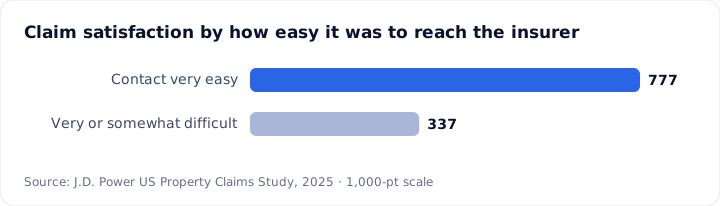
Why contact matters: claim satisfaction in J.D. Power's 2025 study of 5,178 US homeowner claimants was 777 when communicating with the insurer was very easy and 337 when it was very or somewhat difficult [1]. The study does not isolate the phone, but waiting and repeating yourself are what a good call design removes.
of agents prefer customer service go through the agency by phone or other non-online means (Big I, 2026, 1,376 respondents)11
of inbound calls to banking, lending and insurance brands reach a person (Invoca, 2026 call data)12
J.D. Power claim satisfaction: contact very easy vs very or somewhat difficult (1,000-pt scale, 2025, 5,178 claimants)1
average agency client retention; only 18% raised it by 5% or more (Liberty Mutual, 2026, about 1,200 agents)13
The call-by-call split
Sort each call by what a wrong answer costs. If the cost is a repeat call, let the AI finish it. If the cost is a coverage promise, let the AI gather facts and a licensed person answer. If the caller is grieving or frightened, go straight to a person.
| Call | Owner | Why | Guardrail |
|---|---|---|---|
| Policy questions with a fixed answer (due date, ID card, document copy) | AI after identity check | Read-only lookup | Read back; send documents only to the contact on file |
| Payment and renewal reminders | AI | One message, one action | Send a pay link by text; never take card digits aloud |
| First notice of loss intake | AI starts, person finishes | Intake is structured; "am I covered?" is not | Safety check first; injury, fire or total loss go to a person |
| Claim status | AI | Adjuster, last note, next step | No view on whether a claim will be paid |
| Document chasing ("we still need the repair estimate") | AI | Short, predictable | Send an upload link, not a request to read details aloud |
| Quote request | AI gathers, person quotes | Collecting facts is clerical | The AI names no policy, price or carrier |
| Coverage question ("does my policy cover water backup?") | Licensed person | Interpreting a contract | AI logs the exact question and transfers |
| Complaint or denial dispute | Licensed person | Legal exposure | Route on the first sentence |
| Bereavement or a death claim | Person | Grief needs a human voice | AI gathers nothing beyond who is calling and why |
Two points on this table. First, the quote and coverage rows carry the licensing risk. In the US, selling, soliciting and negotiating insurance are defined in state law, and offering advice directly to a buyer can count as negotiating; whether an AI's output can be treated as an agent's advice is still an open question [3]. Second, a payment reminder is the best first outbound call because it is short and easy to measure.
What a good reminder sounds like
The agent names the insurer, gives the amount and due date, offers a pay link by text (sent through your own SMS provider) and asks one question. VoiceGenie does not announce itself as an AI by default, so switch that setting on for this agent.
Hello Anjali, this is Brightway Finance with a quick reminder. Your instalment of two hundred and fifty dollars is due on the fifth. Would you like me to text you a payment link?
In English: Hello Anjali, this is Brightway Finance with a quick reminder. Your instalment of two hundred and fifty dollars is due on the fifth. Would you like me to text you a payment link?
If the caller says "my husband passed away" or "I lost my job," the script stops and hands off. That sentence turns a reminder into a conversation only a person should have.
A first notice of loss, minute by minute
Saturday, 7:50 pm, a burst pipe. The AI answers. With the AI announcement switched on, and the recording notice written into its opening line, it says it is an AI and that the call is recorded. It asks about injury, gas or live water before anything else. It matches the policy, takes when and what, and texts a photo link. When the caller asks "will this be covered?" it says it cannot answer, logs the question and queues a licensed person for Monday at 8:30 with a one-line summary. The caller never repeats the story.
What the AI must never say
Write a do-not-answer list before you write the script: coverage, price, eligibility, whether to file, why a claim was denied. Test it with trap calls.
In Wisconsin guidance, unlicensed staff may answer phones and schedule appointments if they do not discuss coverage or cost. Accepting information that could bind coverage, or advising on benefits and terms, needs a license [2]. That is a state example, not a national rule, but it is a sensible design limit for an AI. No US rule we found addresses AI voice agents on insurance calls directly, so treat the licensing question as open.
The rules, country by country
This map comes from public sources and is general information. Check each rule on the regulator's or official site before you rely on it, because rules change and differ by state.
| Rule | Country | What it means for a voice agent |
|---|---|---|
| State licensing law | US (by state) | Selling, soliciting and negotiating need a license; keep the AI to intake, lookup and routing [2][3]. |
| NAIC AI model bulletin | US (states adopt separately) | Insurers are expected to run a written AI program, vet vendors, seek audit rights and tell consumers when AI is used [4]. Expect questions from carriers. |
| TCPA and FCC 2024 ruling | US | AI-generated voices are artificial voices, so outbound AI calls generally need prior express consent unless an exemption applies [5]. |
| Call recording | US (by state) | Federal law needs one party's consent; 13 states need all parties [6]. Say "AI" and "recorded" in the opening line. |
| Consumer Duty | UK | Firms must act to deliver good outcomes, and consumer support is one of four outcomes [7]. |
| ICOBS 8.1 | UK | Insurers must handle claims promptly and fairly, give reasonable guidance to make a claim, and not reject unreasonably [8]. |
| IRDAI turnaround times | India | Per a law-firm summary: acknowledge and resolve complaints within set days, and settle claims within short windows [9]. |
| TRAI 1600 series | India | IRDAI-regulated entities use the 1600 series for service and transactional calls, with a 15 Feb 2026 deadline [10]. |
What this means in practice
In the US, the AI is on safer ground when it does only what unlicensed staff may do, and when outbound calls rest on consent you can prove. If you buy leads, ask where the consent came from.
In the UK, no FCA page we found bans AI voice agents. The test is outcomes: can a worried customer get support and a clear route to a person [7][8]? A loop with no exit is the failure to avoid.
In India, the speed of claims is regulated, so a voice agent that chases documents quickly helps the insurer meet its clock. The same summary lists death claims without investigation due within 15 days of intimation and cashless health pre-authorization decisions within an hour [9]. TRAI has directed IRDAI-regulated insurers to use the 1600 series for service and transactional calls to customers [10]. Check the final IRDAI text and its effective date.
A 12-week pilot for one call type
Pick the call with one checkable answer. Document and ID card requests, or due-date reminders, are good first choices. Put the AI behind overflow and after hours: if nobody answers in four rings, or after closing, the call forwards to VoiceGenie. Nothing else changes, and you bring your own carrier and numbers.
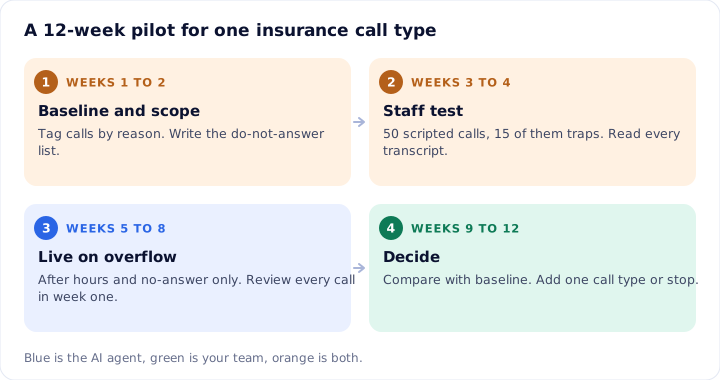
Weeks 1 to 2. Tag two weeks of calls by reason. Log rings to answer, voicemails and abandons by hour. Write the do-not-answer list. Connect your agency system through the open API, webhooks or Zapier so each request lands in a queue.
Weeks 3 to 4. Staff place 50 scripted calls, 15 of them traps such as "am I covered for water backup?" Read every transcript. Test hand-offs in hours and after hours.
Weeks 5 to 8. Turn on forwarding for after hours and no-answer only. Review every call in week one, then a sample plus every transfer.
Weeks 9 to 12. Compare with the baseline. Add one call type or stop.
Measure these, and set exit criteria before you start:
| Measure | How to define it |
|---|---|
| Resolution rate | Requests completed with no repeat call within 7 days; not containment |
| Wrong-answer count | Calls where the AI stated coverage, price or eligibility. Target: zero |
| Hand-off quality | Share of hand-offs where the caller repeated nothing |
| Urgent loss escalation time | Minutes from a flagged injury or fire to a licensed person |
| After-hours calls worked | Logged calls worked by 10 am the next business day |
For definitions, see our guide to measuring an AI voice bot. A 4-minute call is 4 minutes at $0.14 per minute, billed per second; you pay your own carrier directly. Put in your own volumes:
A worked example. Move the sliders to match yours.
AI at $0.14 a minute with volume credit applied, plus Insights seats for the people who take handed-over calls. Phone line charges are your carrier's and are not included. Illustration, not a quote. Open the full calculator
When voice AI is the wrong choice
- Most of your calls are disputes, denials and grief. An AI front door saves little. Spend the effort on tools for your people.
- Your systems cannot be read in real time. An agent that cannot look up status will guess or stall.
- Nobody owns the after-hours hand-off. A summary in an inbox nobody opens is voicemail with extra steps.
- You want the AI to sell or recommend coverage. Do not.
On fit: VoiceGenie covers AI calls and a human desk on one record, so the person sees a summary, the transcript, the caller's mood and what the AI already did. AI agents are billed by usage and human seats per person, and a managed setup is available. VoiceGenie's security program is built to the SOC 2 Type 2, ISO 27001 and ISO 42001 standards, and it handles personal data in line with GDPR. Security documentation is shared on request. Agency and claims systems connect through the API, webhooks or Zapier, not native connectors. If you only need a human desk, a narrower tool may suit you better. For the disclosure question, read ethical considerations of voice bots; for renewals and reminders, see automating follow-ups. Pricing is on our pricing page.
Common questions
Can voice AI take a first notice of loss call?
Yes, for the intake only: a safety check, policy match, date, place, what happened, a photo link and any third parties. It should not say whether the loss is covered or whether to file. Injury, fire, total loss and distressed callers go straight to a person, with the notes already on screen.
Does an AI answering insurance calls need a license?
No US rule we found addresses this directly, so treat it as an open question and design to the limit unlicensed staff already face: answer, look up, schedule and collect facts, but do not discuss coverage, advise on terms or bind. Anything beyond that goes to a licensed person. Verify your state's rules with its insurance department.
Which insurance calls should AI handle first?
Start with calls that have one checkable answer and no advice: document and ID card requests, due dates with a pay link, claim status and renewal reminders. Put the AI behind overflow and after-hours forwarding. Add first notice of loss second, once identity checks and hand-offs work.
Can AI make renewal and payment reminder calls?
Yes, with consent. In the US the FCC treats AI voices as artificial voices under the TCPA, so outbound calls need prior express consent unless an exemption applies. In India, service and transactional calls from insurers go on the 1600 series. Add quiet hours, retry limits and a do-not-call list.
Will policyholders accept an AI on a claim call?
Most care more about waiting and repeating themselves than about the voice. J.D. Power found claim satisfaction of 777 when contact was very easy and 337 when it was difficult. Answer at once, turn on the AI announcement, and offer a person at any point.
Sources
- J.D. Power via Insurance Journal, 2025 U.S. Property Claims Satisfaction Study (5,178 homeowners), 2025
- Axley LLP, The Do's and Don'ts of Unlicensed Customer Service Representatives and Employees (Wisconsin guidance), 2023
- Husch Blackwell, Insurance conversations with a robot, 2024
- NAIC, Model Bulletin: Use of Artificial Intelligence Systems by Insurers, adopted 4 Dec 2023
- Cooley LLP, FCC: AI-generated voices in robocalls are illegal under the TCPA (Declaratory Ruling), 2024
- Kilpatrick Townsend, Wiretap laws in the United States, 2024
- FCA, Consumer Duty: about the Duty
- Kael Tripton, ICOBS 8 Insurance claims handling (summary of FCA Handbook ICOBS 8.1)
- Mondaq, IRDAI's update on turnaround times for insurance companies (summary of the IRDAI circular and 2017 regulations)
- TRAI, Press release No. 151 of 2025 on the 16 Dec 2025 direction to IRDAI-regulated entities (1600 series)
- Insurance Journal, Big I 2026 Agency Universe Study (Future One, Zeldis Research, 1,376 respondents) (2026)
- Invoca, Invoca 2026 Financial Services Lead Conversion Benchmarks (2026)
- Liberty Mutual via IA Magazine, 2026 Independent Agency Growth Study (nearly 1,200 agency principals and staff) (2026)
About this post. The rules, prices and figures here were gathered from public sources and were correct to the best of our knowledge on the date shown. They change, and they differ by country and state. This is general information, not legal or financial advice. Before you act, check the latest position with the regulator or company concerned, using the links above. If you spot an error, write to support@voicegenie.ai.
Founder and Chief Revenue Officer of VoiceGenie. Writes about how sales and customer teams put AI calling to work.
More posts by Maaz Ansari