- Let voice AI book, confirm, move and recall. It can start refill and referral admin. Symptoms, results and triage stay with clinical staff.
- Missed visits are common (7.6% of NHS outpatient slots, 18.8% at one VA center), but no good public figure shows AI calls cut them. Measure your own.
- Do not accept a vendor's HIPAA claim as proof. Ask about a business associate agreement, voicemail content, recording, training use and urgent-call routing.
What voice AI can do for healthcare appointments
Voice AI can book, move, confirm and cancel visits, call patients who are due for a recall, and take the details of a refill or referral request for staff to finish. It should not triage symptoms, give results or decide care. A nurse or clinician takes those. The test is simple: a fact, a form or an open slot goes to the AI. Judgment goes to a person.
Disclosure: VoiceGenie publishes this guide and is one of the vendors in this market. The advice holds whichever tool you pick. For the overview of the whole front desk, see our healthcare page. This post goes deeper for the practice or clinic manager who owns the phones.
The phones matter because the schedule depends on them. In a December 2025 MGMA poll of 236 practice leaders, 27% named no-shows and 22% named phone access as their top patient access focus for 2026 [4].
of healthcare calls missed, versus 14% in home services and 9% in real estate. CallRail benchmark of 1.1 million leads, 7 industries, January 2025.13
of scheduling calls abandoned at VA clinical contact centers in fiscal 2024, against a 5% standard. 14 of 17 centers missed both service standards.14
average wait for a new-patient appointment across six specialties in 15 US metros, up from 26 days in 2022. AMN Healthcare survey of 1,391 offices, 2025.15
average no-show rate across 10 clinics at one large VA medical center, 1997 to 2008, from 12.6% in audiology to 25.7% in gastroenterology. About $196 each in 2008.1
How big the no-show problem is, and what is not proven
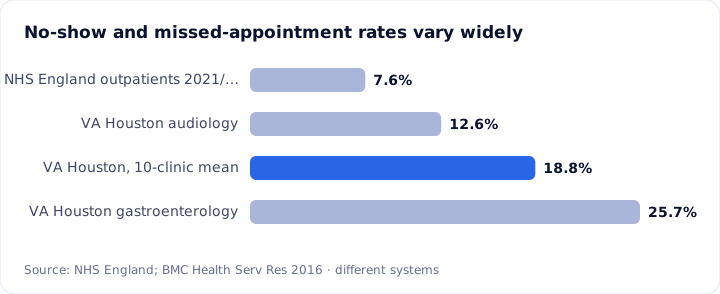
Missed visits are common, and the rate depends heavily on the clinic. NHS England reports that 7.6% of outpatient appointments in 2021/22 ended as did-not-attends, about 650,000 missed slots a month [2]. At one US VA medical center in Houston, the mean no-show rate across 10 clinics from 1997 to 2008 was 18.8%, from 12.6% in audiology to 25.7% in gastroenterology [1].
What helps? NHS England recommends reminders by text, letter or phone, two-way reminders so a patient can rearrange, easy cancelling and rebooking, and short-notice lists to refill freed slots [2]. A Cochrane review of 7 trials with 5,841 people found text reminders raised attendance (relative risk 1.14), and texts and phone calls were about the same (relative risk 0.99, 3 trials) [3]. In the Houston study, reminder letters from 2004 changed little [1].
What I could not find is a strong public study of AI voice calls on no-shows. So treat any vendor's percentage with suspicion, including ours. The case for a voice call is not that it beats a text. It is that it can finish the job: the patient says "I can't make Thursday" and the slot moves in the same call.
Which appointment calls to automate, and which to keep
Sort calls by what a wrong answer costs. A wrong reschedule costs a repeat call. A wrong symptom answer costs a patient.
| Call | Who owns it | Why | Guardrail |
|---|---|---|---|
| Book, move, cancel a visit | AI | Known rules: visit type, length, provider | Book only what the template allows |
| Reminder and confirmation | AI | One message, one action | Offer confirm, move or cancel |
| Recall (overdue checkup, hygiene) | AI | Repeatable outbound work | Respect consent, quiet hours and opt-out |
| Hours, parking, forms, what to bring | AI | Facts that rarely change | Text the link |
| New-patient intake | AI starts, staff finish | Speed matters, fit needs a check | Staff confirm plan and fit |
| Refill request | AI starts, clinician decides | Capture drug, dose, pharmacy | AI never approves or advises |
| Referral chasing | AI starts, staff finish | Chasing is repeatable | Flag missing records to staff |
| "Should I come in?" | Person | Clinical judgment | Route on the first red-flag word |
| Results, diagnoses, bad news | Person | Personal and sensitive | AI never says it first |
| Bill disputes, upset callers | Person | Needs authority and empathy | Send history and mood with the call |
Refills and referrals deserve a note. They are admin until a clinical question appears. Let the AI capture the request and put it in a queue with a deadline. Let a clinician approve. On a referral that has sat for two weeks, the AI can call the patient, offer slots and flag missing records.
What a reminder call sounds like
A good reminder says who is calling, that it is an AI, the visit time, and offers three actions. Here is a sample.
Hello Daniel, I'm calling from City Care Clinic. You have an appointment with Dr Mehta tomorrow at eleven in the morning. Will you be able to make it, or would you like me to move it to another time?
In English: Hello Daniel, I'm calling from City Care Clinic. You have an appointment with Dr Mehta tomorrow at eleven in the morning. Will you be able to make it, or would you like me to move it to another time?
If the patient says "I have been feeling worse," the script stops being a reminder. It moves to a nurse.
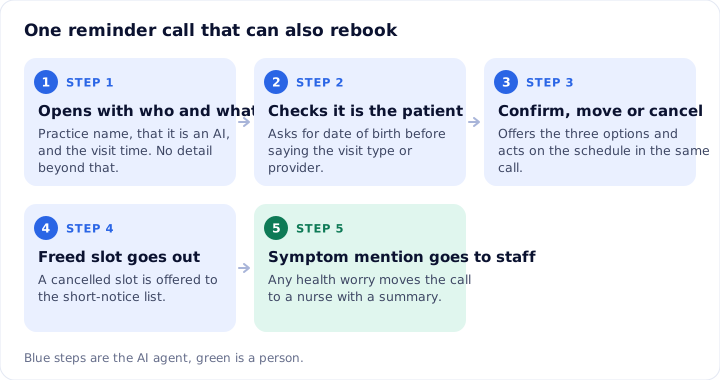
After the opening, the agent checks the date of birth before it says the visit type or provider, then offers confirm, move or cancel, then sends a freed slot to the short-notice list. You configure all five steps. On VoiceGenie the AI announcement is a setting you switch on per agent, and I advise switching it on. A recording notice is not a built-in setting. It is written into the agent's opening line.
Rules in the US, UK and India
This is general information gathered from public sources, not legal advice. Verify each rule with the official source before relying on it.
| Rule | Country | What it means for the call |
|---|---|---|
| Business associate agreement | US | A vendor handling protected health information for a covered entity needs written assurances, in a contract called a BAA [6]. HHS says a cloud service that stores ePHI needs one [7]. |
| Voicemail content | US | Messages are allowed but limit what is said, such as name, number and what is needed to confirm. Honor reasonable confidential-contact requests [5]. |
| AI voices under the TCPA | US | The FCC treats AI-generated voices as artificial voices, so prior express consent is required, and the caller must be identified at the start [8]. |
| Health care message exemption | US | The federal rule exempts some provider calls to cell phones, such as appointment reminders, if all conditions hold: the number the patient gave, the provider named at the start, about one minute, one message a day and three a week, easy opt-out, no marketing or billing [9]. |
| Controller and processor contract | UK | Under UK GDPR, a processor contract sets the purpose, security, sub-processor rules, deletion or return, and audit rights [10]. |
| DPDP Rules | India | The Rules, notified in November 2025, give 18 months for phased compliance [12]. A law firm summary gives 13 May 2027 for notice, consent and other core duties, and lists security terms in processor contracts as a minimum safeguard [11]. |
HIPAA is a US law. The UK and India items concern general data protection, not a medical-calling rule. Check with your own privacy officer which apply to each service.
What to ask any vendor
I will not tell you any vendor is HIPAA compliant, and neither should a vendor in a sales call. Ask each one, in writing:
- Will you sign a business associate agreement before any patient call, and what does it cover?
- Is call audio or text used to train a model, and can we delete recordings and transcripts?
- What does the AI say and do when a caller mentions chest pain, bleeding or a child in trouble?
- How is identity checked before any visit detail is spoken, and where is that logged?
- Can we cap calls per patient, honor opt-outs at once and set quiet hours?
On our side, VoiceGenie's security program is built to the SOC 2 Type 2, ISO 27001 and ISO 42001 standards, and it handles personal data in line with GDPR. Security documentation is shared on request.
How to start without touching the front desk
Pick one narrow job. Reminder and reschedule calls for established patients are the safest first choice. The main number rings your front desk as usual. Calls go to the AI only on overflow, at lunch and after hours.
Weeks 1 to 2: baseline. Tag two weeks of calls by reason. Log unanswered and abandoned calls by hour, and your no-show rate by provider. Write the do-not-answer list with your clinicians: symptoms, results, medication changes, disputes.
Weeks 3 to 4: staff test. Staff place 40 scripted calls, 10 of them traps ("my chest hurts", a wrong birth date, an angry caller). Read every transcript.
Weeks 5 to 8: live on one list. Review every call in week one, then a sample plus every hand-off. Hold back a comparison group of patients who get your old reminder.
Weeks 9 to 12: decide. Compare no-shows, rebooked slots and complaints against the held-out group. Add one call type or stop.
Measure these, and define each in writing:
| Measure | How to define it |
|---|---|
| Task completion | Requests finished and confirmed with no staff fix, from audited calls |
| Urgent-call routing | Red-flag calls that reached a person in your set time. Target: all |
| No-show and late-cancel rate | Missed visits over booked visits, by provider, against the held-out group |
| Slot refill | Freed slots rebooked by the short-notice list |
| Complaints and opt-outs | Per 1,000 calls |
For definitions, see our guide to measuring an AI voice bot. For outbound work in general, see automating follow-ups with a voice assistant.
Cost is simple to estimate. A 45-second reminder is 0.75 minutes at $0.14 per minute, billed per second. You bring your own carrier. Put your volumes in the calculator:
A worked example. Move the sliders to match yours.
AI at $0.14 a minute with volume credit applied, plus Insights seats for the people who take handed-over calls. Phone line charges are your carrier's and are not included. Illustration, not a quote. Open the full calculator
When voice AI is the wrong choice
Skip it, or wait, in these cases:
- Your schedule template is messy. The AI books what the template allows, so confusion spreads faster. Clean up visit types first.
- Your scheduling system cannot be read or written. Without that, the AI can take a request but not finish it. Start with a staff task queue.
- Most of your calls are clinical. If the phones are mainly symptom and results calls, an AI front door saves little.
- Your privacy officer has not signed off. Wait for the agreement and the voicemail wording.
On fit: VoiceGenie handles AI calls and a human desk on one record. When a person takes over, they see a summary, the transcript, the caller's mood and what the AI already did. Practice systems connect through the open API, webhooks or Zapier, not native connectors, and you bring your own carrier. If you want a text-only reminder tool, a narrower product may suit you better. For where the line on honesty sits, read the ethics of voice bots in customer service. Pricing is on our pricing page.
Common questions
Can voice AI book medical appointments?
Yes, when it can read your open slots and write bookings, usually through your scheduling system's API. Where that access is limited, the AI can take the request and file a task for staff. It should book only what your visit types and provider rules allow, and hand anything clinical to a nurse.
Does an AI reminder call reduce no-shows?
Reminders help in general. A Cochrane review found text reminders raised attendance, with relative risk 1.14, and found texts and phone calls similar. I found no strong public study of AI voice calls specifically, so run a held-out comparison on your own schedule before you claim a result.
Is a voice AI agent HIPAA compliant?
That depends on the vendor, the setup and your contract, not on the word AI. In the US, a vendor that handles protected health information for you generally needs a business associate agreement with you. Ask for it, and for the other items in the vendor checklist below, in writing.
What can a reminder say on voicemail?
Very little. HHS says providers may leave messages on answering machines but should limit what is disclosed, such as the practice name, a number and what is needed to confirm an appointment. Leave out the diagnosis, test, drug and balance, and honor patients' reasonable requests for confidential contact.
What should happen when a patient mentions symptoms?
The AI should stop the routine call, tell the caller to dial the emergency number if it is urgent, and bring in a nurse or the on-call line with a summary. Your clinicians write the red-flag list. Test it with scripted trap calls before launch and review every urgent call afterward.
Sources
- Kheirkhah et al., Prevalence, predictors and economic consequences of no-shows, BMC Health Services Research, 2016
- NHS England, Reducing did not attends (DNAs) in outpatient services
- Cochrane Library, Text message reminders for improving attendance at health appointments (CD007458), 2013
- MGMA Stat, Patient access priorities for 2026 (236 responses), 2025
- HHS, May health care providers leave messages for patients at their homes? (HIPAA FAQ 198)
- HHS, Business Associates guidance
- HHS, Use of a cloud service to store or process ePHI (HIPAA FAQ 2075)
- FCC, Declaratory Ruling FCC 24-17 on AI-generated voices under the TCPA, 2024
- 47 CFR 64.1200(a)(9)(iv), health care provider exemption (Cornell LII copy of the federal rule)
- ICO, What needs to be included in the contract (controllers and processors)
- Mondaq, India's Digital Personal Data Protection framework comes into effect (law firm summary of the DPDP Rules, 2025)
- Government of India, PIB, Digital Personal Data Protection Rules, 2025 (notified 14 November 2025)
- CallRail via Business Wire, CallRail benchmark report for small businesses (1.1 million leads, 7 industries) (2025)
- VA Office of Inspector General, Review of Clinical Contact Centers to Assess Leadership and Oversight, report 25-00228-214 (2025)
- AMN Healthcare, 2025 Survey of Physician Appointment Wait Times (1,391 offices, 15 metros) (2025)
About this post. The rules, prices and figures here were gathered from public sources and were correct to the best of our knowledge on the date shown. They change, and they differ by country and state. This is general information, not legal or financial advice. Before you act, check the latest position with the regulator or company concerned, using the links above. If you spot an error, write to support@voicegenie.ai.
Founder and Chief Revenue Officer of VoiceGenie. Writes about how sales and customer teams put AI calling to work.
More posts by Maaz Ansari