- Automate calls with one right answer: balances, card status, due dates, appointments, document chasing. Keep disputes, fraud claims, hardship and advice with people.
- Never ask a caller to speak a full card number or a one-time passcode to the AI. Send a code to the phone on file, and treat a voice as a claim, not proof.
- Rules differ by country: TCPA and Regulation F in the US, Consumer Duty in the UK, RBI recovery directions and the 1600 series in India. Pilot one call type first.
Where voice AI is safe and worth it at a bank
Voice AI is safe and worth it at a bank on calls with one correct answer: balance and transaction questions, card status, payment and EMI reminders, appointment booking and document chasing. It is not safe on disputes, fraud claims, hardship, complaints or advice. Those need judgment. Verify identity before any account detail, say it is an AI, record the call, and keep a person one request away.
Disclosure: VoiceGenie publishes this guide and is one of the vendors in this market. The advice below holds whichever tool you pick, and a section near the end says when ours is the wrong choice. For the full operating picture, see our financial services page. This post goes deeper on the questions a head of contact center, digital or collections asks before a pilot.
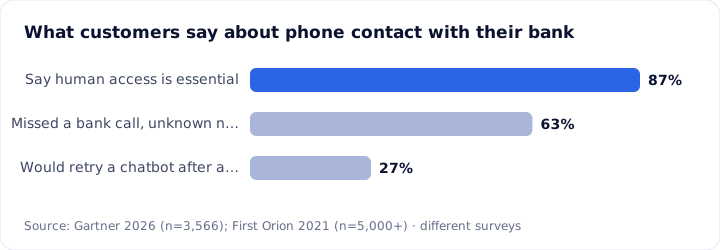
The case for starting is the phone itself. Average speed to answer in US contact centers rose from 31 seconds in 2012 to 99 seconds in 2024, and 8.9% of calls were abandoned [22]. Outbound is no easier: 63% of US mobile subscribers in a late-2021 survey said they had missed a call from their bank because they did not recognize the number [20].
Average speed to answer in US contact centers, 2024, up from 31 seconds in 2012 (ContactBabel decision-makers' survey)22
of US mobile subscribers said they missed a call from their bank because they did not recognize the number (First Orion survey of 5,000+, late 2021)20
reported lost to US imposter scams in 2025; bank impersonators led business-impersonation losses (FTC, June 2026)11
of 100 US banking customers surveyed said they stopped using their institution after repeated bad contact-center experiences (Deloitte, 2026, small sample)24
Customers are also wary. In a 2026 Gartner survey of 3,566 customers, 87% said access to a human is essential when companies use generative AI, and only 27% would try a chatbot again after a bad experience [19]. The CFPB found the same pattern in 2023: chatbots stall when problems get complicated, and customers get trapped in loops with no route to a person [21].
Which banking calls to automate first, and which to keep
Sort every call by what a wrong answer costs. If the cost is a repeat call, let the AI finish it. If the cost is money moved or a regulator's clock, let the AI collect the facts and a person decide. If the caller is distressed, go straight to a person.
| Call type | Who owns it | Why | Guardrail |
|---|---|---|---|
| Branch hours, routing number, wire cutoff | AI | Public facts, no account data | Text the address or link |
| Balance and recent transactions | AI after identity check | Read-only, high volume | Read back only the last few items; no full account numbers aloud |
| Card activation | AI after identity check | Short, scripted, one outcome | Code to the phone on file |
| Card block (lost or stolen) | AI starts, person finishes | Speed matters, replacement needs judgment | Lock first, then confirm address and pending charges with a person |
| Payment and EMI reminders | AI | One message, one action | Send a secure pay link; never take card digits on the call |
| Appointment and callback booking | AI | Calendar lookup and a confirmation text | Offer a person for anything else |
| KYC and document follow-up | AI | "Your proof of address is still missing" | Collect nothing sensitive by voice; send an upload link |
| Dispute of a charge or transfer | AI starts, person decides | Oral notice can start a clock | Time-stamp the report, collect facts, hand off |
| Fraud claim, scam in progress | Person | Money may be leaving now | Route on the first sentence |
| Hardship, bereavement, complaints | Person | Empathy and authority | AI may gather the reason; never negotiate |
| Product advice, rates, eligibility | Person | Regulated judgment | AI books a licensed adviser |
Two notes on this table. First, a payment reminder is the best first outbound call: short, predictable, and easy to measure. Second, the dispute row matters in the US. A notice of error under Regulation E can be oral, and investigation periods run from when the bank is told [7]. A voice agent that time-stamps every report to the minute protects you. One that lets a caller drift into a vague chat does not.
What a good reminder call sounds like
A good reminder states who is calling and that it is an AI, names the amount and date, offers a pay link by text, and asks one question. Here is a sample.
Hello Anjali, this is Brightway Finance with a quick reminder. Your instalment of two hundred and fifty dollars is due on the fifth. Would you like me to text you a payment link?
In English: Hello Anjali, this is Brightway Finance with a quick reminder. Your instalment of two hundred and fifty dollars is due on the fifth. Would you like me to text you a payment link?
If the caller says "I lost my job" or "I can't pay," the script stops selling and hands off. That sentence is where a reminder becomes a hardship call.
How identity checks work on an AI call, and what never to do
Match the check to the risk. Public facts need none. Account details need a check. Anything that moves money, resets credentials or changes contact details needs a stronger one, or a person.
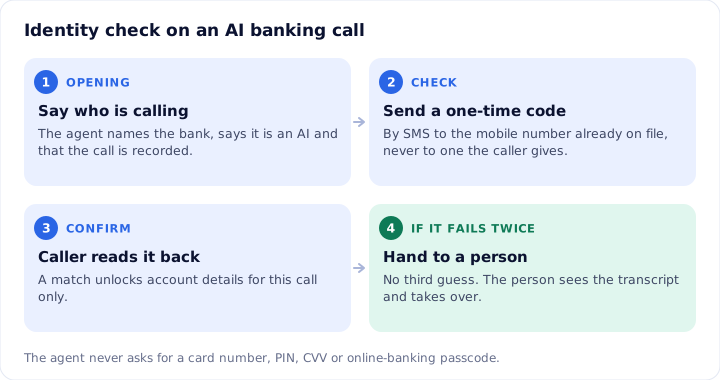
A workable pattern:
- The AI says it is an AI and that the call is recorded. On VoiceGenie neither line is automatic: the AI announcement is a setting you switch on, and the recording notice is written into the agent's opening line.
- It sends a one-time code by SMS to the mobile number already on file, never to a number the caller supplies. The code is sent through your SMS provider or through the bank's own API, which the agent triggers during the call.
- The caller reads the code back. The code is for the bank's check; the AI never asks for a different one.
- A mismatch twice sends the call to a person. It does not trigger a third guess.
- High-risk actions get a call-back to a pre-registered number or go to a person.
US interagency guidance says knowledge-based questions alone are not reliable, and it names call center staff as a social-engineering target [6]. Treat an AI agent the same way.
Do not store what you do not need. Redact card numbers and account numbers in transcripts, limit who can play recordings, and set a retention period that compliance has approved. If a caller refuses the check, the answer is a person, not a workaround.
Fraud and voice cloning: what the evidence says
Fraudsters call banks as well as customers. They also call customers pretending to be the bank. In 2025, US consumers reported $3.5 billion in losses to imposter scams, and bank impersonators led business-impersonation losses [11].
Voice cloning raises the stakes for any check that relies on how someone sounds. The FTC warns that scammers use cloned voices to make requests for money or information more believable [10]. In July 2025, OpenAI's CEO told a Federal Reserve conference that AI has "fully defeated" voiceprint authentication, and that some banks still use it [9]. That is one executive's view as reported by the press, but it matches the direction of regulator warnings. FinCEN's November 2024 alert said it was seeing more suspicious activity reports that describe deepfake media used to get past verification [8].
What banks can do on the phone:
- Treat a voice as a claim, never as proof. If you keep a voiceprint, use it as one signal beside a code or a device check.
- Use out-of-band verification, so the second factor travels on a channel the caller on the line does not control.
- Print your outbound identity. When customers do not recognize your number, they miss real calls [20], and fraudsters borrow that gap. Use a consistent caller ID and tell customers which numbers you use.
- Never ask customers to move money during a call. A bank that does is training them to obey a scammer.
- Route any "someone told me to move my money" call to a person on the first sentence.
An AI agent is also a new target. Test it with scripted attacks: a caller who claims to be a branch manager, a caller who reads out a stolen date of birth, a caller who says "just this once." The agent must refuse the same way every time.
The rules, country by country
This map was gathered from public sources and is general information, not legal advice. Confirm each rule on the regulator's own site, linked in the sources, before you rely on it. Each rule is labeled with where it applies.
| Rule | Country | What it means for a voice agent |
|---|---|---|
| TCPA and the FCC's 2024 ruling | US | AI-generated voices, including cloned ones, are "artificial" voices. Callers need prior express consent, and marketing calls need prior express written consent [1]. Narrow fraud and breach alert exemptions exist, with limits on count and length [23]. |
| Recording consent | US (by state) | Federal law needs one party's consent. The Reporters Committee lists 13 states that need all parties for phone calls [18]. Say "this call is recorded" first. |
| FDCPA and Regulation F | US | For debt collectors as the FDCPA defines them: calls before 8 a.m. or after 9 p.m. local time are presumed inconvenient [3], and more than seven calls in seven days, or a call within seven days after a conversation, creates a presumption of violation [2]. |
| GLBA | US | Customers get privacy notices, and oral notices alone do not comply. Sharing data with a service provider needs a contract that limits its use [5]. |
| Consumer Duty | UK | Applies to retail customers: act in good faith, avoid foreseeable harm, and support customers' goals, across four outcomes including consumer support [12][13]. |
| Vulnerable customers (FG21/1) | UK | The FCA saw vulnerability as a spectrum, found 53% of adults showed a characteristic in October 2020, and expects firms to offer multiple channels [14]. |
| RBI recovery directions | India | For NBFCs, calls and visits only between 8:00 and 19:00 unless the borrower asks otherwise, calls recorded, and recordings kept six months [15]. |
| RBI voice-call fraud circular and TRAI rules | India | Service and transactional calls on the 1600 series, promotional calls on 140, no mixing, and no other 10-digit numbers [17]. |
United States
For the TCPA, the practical points are consent and identification. The 2024 ruling covers AI that simulates a human voice, and clones of a real person's voice [1]. The ruling does not ban AI calls. It says the consent rules already apply.
Regulation F applies to "debt collectors" as the FDCPA defines the term [4]. A bank collecting its own loans may not be one, but many banks follow the same limits by policy and state law may add more. Check which applies to each portfolio, then configure calling hours, call counts and quiet periods in the dialer, not in the script.
United Kingdom
I found no FCA page that bans AI voice agents. The test is outcomes. Consumer Duty asks whether customers can get support and understand what is happening [12][13]. A voice agent that traps a worried customer in a loop is a Consumer Duty problem. Build triggers for vulnerability: a mention of bereavement, illness, job loss or confusion moves the call to a trained person [14].
India
For recovery, the RBI's August 2026 NBFC directions limit calls to 8:00 to 19:00 and require recording; they take effect on 1 January 2027 [15]. A draft for commercial banks proposed the same window and recording rules from 1 October 2026 [16]. Check the RBI's site for the final bank text before you rely on it. Separately, the RBI's 2025 circular tells banks and NBFCs to use registered headers and the 1600 series for service calls, and the 140 series for promotional ones [17]. A reminder that also pitches a new loan is a mixed call, and the circular says not to mix them.
How to pilot one call type, and what to measure
Pick the call with one checkable answer. Payment reminders and card activation are good first choices because no money decision happens on the call.
Weeks 1 to 2: baseline. Tag two weeks of calls by reason. Record answer speed, abandonment and repeat calls by hour. Write the do-not-answer list: rates, eligibility, fee waivers, anything disputed.
Weeks 3 to 4: staff test. Staff place 50 scripted calls, 15 of them traps ("why was I declined?", "just read me the balance, I lost my phone"). Read every transcript.
Weeks 5 to 8: live on one list. Start with overflow or one outbound list. Review every call in week one, then a sample plus every hand-off.
Weeks 9 to 12: decide. Compare to the baseline. Add one call type or stop.
Measure these:
| Measure | How to define it |
|---|---|
| Resolution rate | In-scope calls where the reason was handled and no repeat call came within 3 business days |
| Wrong-answer count | Calls where the AI gave a rate, an opinion on eligibility, or a reason for a decision. Target: zero |
| Hand-off quality | Share of sampled hand-offs where the person did not re-ask identity or reason |
| Promise-to-pay or payment rate | Reminders followed by a payment within a set window, against a held-out group |
| Opt-out and complaint rate | Opt-outs and complaints per 1,000 calls |
| Answer speed and abandonment | Seconds to answer and share of calls that hang up, by hour |
Do not stop at containment, the share of calls that never reach a person. A caller who gives up counts as contained. For definitions, see our guide to measuring an AI voice bot.
Cost is easy to estimate. A 90-second reminder costs 1.5 minutes at $0.14 per minute, billed per second, plus your phone line. Put your own volumes in the calculator:
A worked example. Move the sliders to match yours.
AI at $0.14 a minute with volume credit applied, plus Insights seats for the people who take handed-over calls. Phone line charges are your carrier's and are not included. Illustration, not a quote. Open the full calculator
When voice AI is the wrong choice
Skip it, or delay, in these cases:
- Your core systems cannot be read in real time. An agent that cannot look up status will guess or stall. Fix the data first.
- Your caller mix needs judgment. If most calls are disputes and hardship, an AI front door saves little. Put the effort into agent tools.
- Compliance has not signed the disclosure, recording and consent wording. Wait.
- You want a voice agent to decide credit or collect on a threat. Do not.
On fit: VoiceGenie covers AI calls and a human desk on one record, and you bring your own carrier. VoiceGenie's security program is built to the SOC 2 Type 2, ISO 27001 and ISO 42001 standards, and it handles personal data in line with GDPR. Security documentation is shared on request. Your security review should still ask for the evidence it needs. Core banking and loan systems connect through the open API, webhooks or Zapier, not native connectors. If you only need a pure IVR or a human-only desk, a narrower tool may suit you better. For how voice AI differs from a menu, read conversational voice AI vs IVR, and for the ethics of disclosure, see ethical considerations of voice bots. Pricing is on our pricing page.
Common questions
Can voice AI handle banking calls safely?
Yes, for the right calls. Start with calls that have one correct answer and no judgment, such as branch hours, payment due dates and appointment booking. Verify identity before any account detail is spoken, record the call, say it is an AI, and let the caller reach a person at any point. Keep disputes, hardship and advice with staff.
Can a bank use AI to make payment reminder calls?
Yes, with limits that depend on the country. In the US, the FCC treats AI voices as artificial voices under the TCPA, so consent is required before such calls. In India, transactional calls go out on the 1600 series and recovery calls fall between 8:00 and 19:00. Check these with counsel before launch.
How do you verify a customer on an AI phone call?
Do not rely on questions a fraudster can answer or on a voiceprint alone. Send a one-time code to the phone number already on file, or call back to a known number, and let the customer read it back. Failures go to a person. Public facts, such as branch hours, need no check.
Is voice authentication still safe against voice cloning?
Treat it as weak on its own. OpenAI's CEO told a Federal Reserve conference in July 2025 that AI has defeated voiceprint authentication, and FinCEN warned banks about deepfake fraud in 2024. Use voice as one signal and add a second factor, such as a code to a registered device.
What should a bank measure in a voice AI pilot?
Measure resolution, not containment: in-scope calls where the reason was handled and the customer did not call again within three business days. Add wrong-answer count, hand-off quality, abandonment and speed to answer, and compare each against your own two-week baseline taken before the pilot starts.
Sources
- FCC, Declaratory Ruling FCC 24-17 on AI-generated voices under the TCPA, 2024
- CFPB, Regulation F, 12 CFR 1006.14 Harassing, oppressive, or abusive conduct
- CFPB, Regulation F, 12 CFR 1006.6 Communications in connection with debt collection
- CFPB, Regulation F, 12 CFR Part 1006 overview
- FTC, How to Comply with the Privacy of Consumer Financial Information Rule of the Gramm-Leach-Bliley Act (2002 guide)
- FFIEC, Authentication and Access to Financial Institution Services and Systems, 2021
- Federal Reserve, Consumer Compliance Outlook, Error Resolution Procedures Under the EFTA and Regulation E, 2025
- FinCEN, Alert FIN-2024-Alert004 on deepfake media fraud schemes, 13 Nov 2024
- PYMNTS, Sam Altman Says AI Has Defeated Bank Voice ID Protections (report of remarks at a Federal Reserve conference, 22 July 2025)
- FTC, Family emergency scams (consumer alert on voice cloning)
- FTC, data on imposter scams, 2025 losses, 2026
- FCA, Consumer Duty: about the Duty
- FCA, Policy Statement PS22/9, A new Consumer Duty, 2022
- FCA, Guidance for firms on the fair treatment of vulnerable customers (FG21/1)
- Reserve Bank of India, NBFC Responsible Business Conduct Third Amendment Directions, 2026 (RBI/2026-27/230, 6 Aug 2026)
- Reserve Bank of India, Draft Commercial Banks Responsible Business Conduct Amendment Directions, 2026
- Reserve Bank of India, Circular RBI/2024-25/105, Prevention of financial frauds perpetrated using voice calls and SMS, 17 Jan 2025
- Reporters Committee for Freedom of the Press, Reporter's Recording Guide: Introduction
- Gartner, Only 27% of Customers Would Try a Chatbot Again After a Negative Experience, 2026
- First Orion, 2022 Financial Services Customer Communications Report
- CFPB, Chatbots in consumer finance, 2023
- ContactBabel, US Contact Center Decision-Makers' Guide, 17th edition, 2025
- Smith Debnam law firm summary of the FCC 2015 TCPA order on fraud and breach alerts
- Deloitte Insights, AI-assisted customer service in banks (2026 Global Contact Center Survey) (2026)
About this post. The rules, prices and figures here were gathered from public sources and were correct to the best of our knowledge on the date shown. They change, and they differ by country and state. This is general information, not legal or financial advice. Before you act, check the latest position with the regulator or company concerned, using the links above. If you spot an error, write to support@voicegenie.ai.
Founder and Chief Revenue Officer of VoiceGenie. Writes about how sales and customer teams put AI calling to work.
More posts by Maaz Ansari