- Automate calls with one right answer: balance, recharge, bill lines, outage and porting status, reminders. Keep retention, disputes and fraud with people.
- Treat SIM swap and port-out requests as a person's job. A voice, or a caller ID, is not proof of who owns the number.
- Start with one IVR option and one call type. Check FCC, Ofcom or TRAI rules for your country, and keep a person one request away.
Where voice AI fits in telecom customer service
Voice AI fits telecom customer service on calls with one correct answer in your systems: balance and usage, recharge and plan change, bill line explanations, outage status, porting status and payment reminders. It does not fit retention, disputes, fraud or SIM-swap requests. Put it behind one IVR option, say it is an AI, record the call, and keep a person one request away.
Disclosure: VoiceGenie publishes this guide and is one of the vendors in this market. The advice holds whichever tool you pick, and a section near the end says when ours is the wrong choice. For the general operating picture, see our customer support page. This post goes deeper for a customer-service or digital lead at an operator.
Telecom is a phone-heavy business. Users call when the line is down, a bill looks wrong or a recharge failed. Average speed to answer in US contact centers was 99 seconds in 2024, and 8.9% of calls were abandoned [10]. Customers are also wary of machines. In a 2026 Gartner survey of 3,566 customers, 87% said access to a human is essential when companies use generative AI [11]. So the design goal is simple: finish the routine call fast, and make the hard call easy to hand over.
Which telecom calls to automate first, and which to keep
Sort each call by what a wrong answer costs. If the cost is a repeat call, let the AI finish it. If the cost is a number taken over, a missed regulator clock or a lost customer, a person decides.
| Call | Owner | Why | Guardrail |
|---|---|---|---|
| Balance, data and validity check | AI | One lookup, high volume | Verify the caller; text a usage summary |
| Recharge and plan change | AI starts, payment by link | Short and scripted | Send a secure pay link; never take card digits by voice |
| Bill explanation | AI explains lines, person fixes errors | The AI can read the invoice | Credits, waivers and disputes go to a person |
| Outage or fault status | AI | Same answer for every caller in the area | Give the fix estimate from the system; never guess one |
| Porting status | AI reads status | A lookup against a port request | The AI never issues or releases a porting code |
| Payment reminders | AI | One message, one action | Quiet hours, retry limits and do-not-call suppression |
| Retention and cancellation | Person | Money and goodwill depend on the offer | AI recognizes the intent and transfers with the reason |
| Billing dispute, complaint repeat | Person | Authority and empathy | AI collects the facts and a time stamp |
| SIM swap, port-out, fraud | Person | The wrong approval hands over someone's number | Route on the first sentence |
Two notes. First, a balance and usage call is the best first call: no money moves and a wrong answer is easy to spot. Second, the rules sit under the table. Ofcom's General Conditions ask for accurate billing and adequate billing information [5], so a bill explanation must read the real invoice, not a summary the AI invented. In India, the regulator expects a complaint to get a docket number by SMS with the expected resolution time [7], and an AI agent can send that text during the call.
What a bill or outage call looks like
A good call states who is calling and that it is an AI, reads back what it understood, answers from the account, and offers a text. Here is a payment reminder sample.
Hello Anjali, this is Brightway Finance with a quick reminder. Your instalment of two hundred and fifty dollars is due on the fifth. Would you like me to text you a payment link?
In English: Hello Anjali, this is Brightway Finance with a quick reminder. Your instalment of two hundred and fifty dollars is due on the fifth. Would you like me to text you a payment link?
When the caller says "my line is dead and I need it for work," the script stops explaining and moves to a person or a fault ticket. That sentence is where status becomes service recovery.
What stays with people: retention, disputes and SIM-swap risk
Three call types stay human by default.
Retention. A caller who says "cancel my plan" is a revenue decision. The AI should say a person will help, pass the reason, and transfer at once. A person sees the account, the tenure and the offer limits.
Disputes. A bill dispute or a repeat fault complaint is where a regulator may look. In India, TRAI says billing complaints are resolved within four weeks, and an unsatisfied customer can appeal to the provider's Appellate Authority, within 30 days after the deadline [6]. In the UK, Ofcom's rules require complaints procedures and membership of an alternative dispute resolution scheme for small business customers [5]. The AI's job is to collect facts, log the time and hand off cleanly.
SIM swap and port-out. Fraudsters ask to move a number to a SIM they hold. The FCC adopted SIM swap and port-out fraud rules in November 2023, and its page stresses that authentication must serve customers without data plans or data-enabled devices, and customers with different skills or disabilities [1]. For a voice agent, that means two things. A voice is a claim, not proof, and a code sent only to an app fails customers without one.
An AI agent is also a target. Test it with scripted attacks: a caller who says he is the account holder's husband, a caller with a stolen date of birth, a caller who says "just this once." The agent must refuse the same way every time.
Multilingual calls: test on real audio
Many operators serve callers who switch between two languages mid-sentence. VoiceGenie supports 90+ languages, and you can see the range on our languages page. Support on a spec sheet is not the same as quality on a noisy mobile line, so test each language you plan to launch.
Here is a payment reminder in Hindi, the kind of call an Indian operator would place. Listen for how it handles the amount and the date.
नमस्ते, क्या मेरी बात अंजलि जी से हो रही है? जी, मैं सुविधा फ़ाइनेंस से बोल रही हूँ। आपकी इस महीने की EMI पाँच तारीख़ को due है। क्या मैं payment link SMS पर भेज दूँ?
In English: Hello, am I speaking with Anjali ji? I am calling from Suvidha Finance. Your EMI for this month is due on the fifth. Shall I send the payment link by SMS?
Rules for multilingual calls:
- Ask for the language early, and let the caller change it at any point.
- Keep plan names, amounts and dates consistent across languages; read numbers back.
- Test with your own accents and your own brand terms.
- Send a person any caller the AI misunderstands twice.
Putting AI behind one IVR option
Do not replace the IVR. Add one option to it. Press 2 for balance and usage forwards to a number the AI answers. Zero or the word agent still reaches your queue. VoiceGenie does not sell the phone line: you bring your own carrier and numbers, so the phone system stays as it is.
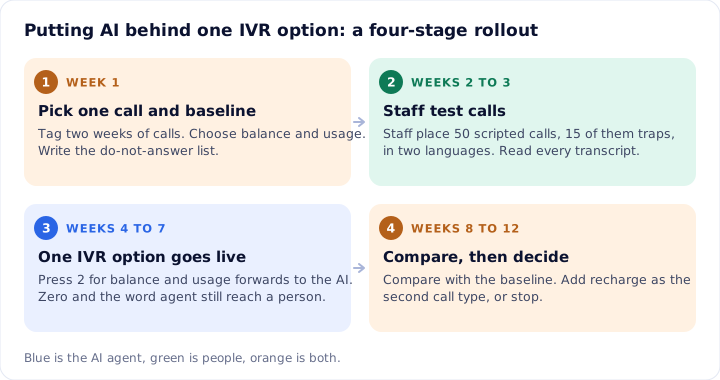
Week 1: pick one call and baseline. Tag two weeks of calls by reason. Choose balance and usage. Write the do-not-answer list: offers, credits, anything disputed.
Weeks 2 to 3: staff test calls. Staff place 50 scripted calls, 15 of them traps, in two languages. Read every transcript.
Weeks 4 to 7: one IVR option goes live. Review every call in the first week, then a sample plus every hand-off.
Weeks 8 to 12: compare, then decide. Compare with the baseline. Add recharge as the second call type, or stop.
When a person takes over, they see a summary, the transcript, the caller's mood and what the AI already did. That matters because a caller who repeats everything blames the operator, not the machine. Measure resolution, not containment: calls where the reason was handled and the caller did not call again within three business days. See our guide to measuring an AI voice bot.
The rules, country by country
This map was gathered from public sources and is general information. Each rule comes from a regulator page linked in the sources, so verify it on the official site before you rely on it. Rules change.
| Rule | Country | What it means for a voice agent |
|---|---|---|
| TCPA and AI voices | US | The FCC says artificial or prerecorded voice rules cover AI technologies that generate human voices, so calls need the called party's prior express consent [2]. |
| SIM swap and port-out rules | US | Authentication must serve customers without data plans or data devices [1]. Keep voice agents away from approvals. |
| Automatic compensation | UK | Under Ofcom's scheme, providers pay £10.34 a day for loss of service after two full working days, £32.31 for a missed engineer appointment, and £6.46 a day for a delayed start [3]. |
| General Conditions | UK | Accurate billing, adequate billing information, and complaints procedures with an ADR scheme for small business customers [5]. |
| Complaint redressal | India | A call centre first, then an Appellate Authority. Docket number by SMS [6][7]. |
| Number portability | India | A porting code only for eligible numbers, valid 4 days in most areas; porting takes 3 working days within a circle and 5 days across circles under the 2019 notice [8]. |
| 140 and 160 series | India | The 160 series is reserved for service and transactional calls; the 140 series is used for commercial calls by telemarketers, promotional ones included [9]. Do not mix reminders and promotions. |
United States
The ruling does not ban AI calls. It says consent rules already apply [2]. Configure quiet hours, retry limits and suppression in the dialer, not in the script.
United Kingdom
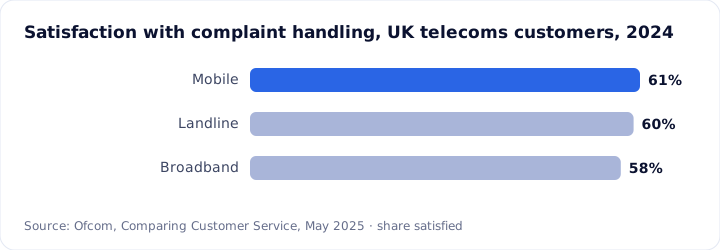
I found no Ofcom page that bans AI voice agents. The test is outcomes. Complaint-handling satisfaction in 2024 was 61% for mobile, 60% for landline and 58% for broadband [4], and the compensation amounts above [3] show what a missed repair costs. A voice agent that loops a caller with a dead line is a risk.
India
TRAI's May 2024 direction reserves the 160 series for service and transactional calls, and the 140 series is for commercial calls such as promotions [9]. Check TRAI for any change to porting timelines since 2019 before you script a porting-status call.
When voice AI is the wrong choice
Skip it, or wait, in these cases:
- Your billing and network status cannot be read in real time. An agent that cannot look up status will guess or stall. Fix the data first.
- Most of your calls are disputes, retention and fraud. An AI front door saves little. Put the effort into your agents' tools.
- Nobody has signed the disclosure, recording and consent wording. Wait.
- You want the AI to approve SIM changes or offer retention discounts. Do not.
On fit: VoiceGenie covers AI calls and a human desk on one record, and AI minutes are $0.14 per minute, billed per second. Human agents are a per-seat license from $29 a month. VoiceGenie's security program is built to the SOC 2 Type 2, ISO 27001 and ISO 42001 standards, and it handles personal data in line with GDPR. Security documentation is shared on request. Billing and network systems connect through the open API, webhooks or Zapier, not native connectors. If you only need a menu or a human-only desk, a narrower tool may suit you better. For how voice AI differs from an IVR, read conversational voice AI vs IVR, and for disclosure, see ethical considerations of voice bots. Pricing is on our pricing page.
Common questions
Can voice AI handle telecom customer service calls?
Yes, for calls with one correct answer in your systems: balance and usage, recharge and plan change, bill line explanations, outage status, porting status and payment reminders. Keep retention, billing disputes, fraud and SIM-swap requests with people. Start with one call type behind one IVR option and measure whether the caller needed to call again.
How do you add voice AI to an existing telecom IVR?
Add one IVR option, such as press 2 for balance and usage, that forwards to a number the AI answers. Pressing zero or saying agent still reaches your queue. Because you bring your own carrier and numbers, the phone system stays as it is, and you can widen the option after a sample review.
Is voice AI safe against SIM-swap fraud?
Only if you keep it away from the risky requests. A SIM change or port-out lets someone take over a number, so the AI should collect the request and pass it to a trained person. Do not treat a voice or caller ID as proof. The FCC adopted SIM swap and port-out fraud rules in November 2023.
Can voice AI support regional languages for telecom calls?
Yes. VoiceGenie supports 90+ languages, but quality varies by accent and line, so test each language on real call audio before you route live callers. Offer the language choice early, keep names and plan terms consistent in each language, and send a person any caller the AI cannot understand.
Do telecom companies have to tell customers they are talking to an AI?
Rules vary by country and are changing, so check the regulator. In the US the FCC says the TCPA covers AI-generated voices, so consent rules apply to those calls. Telling callers it is an AI, and that the call is recorded, is the safest practice. On VoiceGenie both lines are set up by you in the agent.
Sources
- FCC, SIM Swap and Port-Out Fraud Report and Order and FNPRM, adopted 15 Nov 2023
- FCC, FCC Confirms that TCPA Applies to AI Technologies that Generate Human Voices
- Ofcom, Automatic compensation: what you need to know (amounts checked 17 Nov 2026; Ofcom says they rise yearly)
- Ofcom, Comparing Customer Service complaints report, published 22 May 2025 (2024 data)
- Ofcom, General Conditions that protect business customers
- TRAI, Redressal of Consumer Grievances (FAQ)
- TRAI, Complaints (FAQ)
- TRAI, Notice on the revised mobile number portability process, effective 16 Dec 2019
- TRAI, Direction on the 140 and 160 number series, 4 May 2024
- ContactBabel, US Contact Center Decision-Makers' Guide, 2025
- Gartner, Survey Finds 87% of Customers Say Companies Using GenAI Must Provide Access to a Human Agent, 2026
About this post. The rules, prices and figures here were gathered from public sources and were correct to the best of our knowledge on the date shown. They change, and they differ by country and state. This is general information, not legal or financial advice. Before you act, check the latest position with the regulator or company concerned, using the links above. If you spot an error, write to support@voicegenie.ai.
Founder and CEO of VoiceGenie. Writes about how AI agents and human teams share the phone work, and what it takes to run them on real calls.
More posts by Anurag Jain