- Give voice AI the calls that are lookups or written rules: order status, return starts, address changes before the label prints, COD and order confirmations.
- Keep refunds outside policy, damaged or lost parcels, fraud holds and upset callers with people. The AI gathers the file and hands off.
- Never let card numbers reach the AI or the recording. Send a pay link. Get consent before any outbound call, and pilot well before the holiday peak.
Which ecommerce calls voice AI should take
Voice AI should take ecommerce calls that are a lookup or a written rule: where is my order, starting a return, fixing an address before the label prints, confirming a cash-on-delivery order and sending a pay link after a failed payment. People should keep refunds outside policy, damaged or lost parcels, fraud holds and upset callers. The AI gathers the file first.
Disclosure: VoiceGenie publishes this guide and is one of the vendors in this market. The advice holds whichever tool you pick, and a section near the end says when ours is the wrong choice. For the product view, see our ecommerce page. This post is for the support lead who has to decide, call type by call type, what changes on Monday.
Why start with the phone? Because shoppers use it when something is wrong. In a late-2021 survey of 5,000 US mobile subscribers, 55% preferred a phone call for an urgent order issue, up from 30% in 2020 [2]. Meanwhile the average US contact center took 99 seconds to answer in 2024, and its call abandonment rate was 8.9% [3].
Forecast US retail returns in 2025: 15.8% of sales and 19.3% of online sales (NRF and Happy Returns)4
of 1,348 US online shoppers had a late package last year; 23% were marked delivered but never got it (Narvar, 2026)1
of 5,000 US mobile subscribers prefer a phone call for an urgent order issue, up from 30% in 2020 (First Orion, late 2021)2
of voluntary subscription cancellations come at the first two renewals (Recharge, 20,000+ brands, Jul 2025 to Mar 2026)12
Where-is-my-order calls
This is the best first call to automate. It moves no money, and the answer sits in your order system and carrier feed. Take the 7:15 pm caller whose jacket still says "processing" and who moves on Friday. A person is gone for the day. The AI can answer.
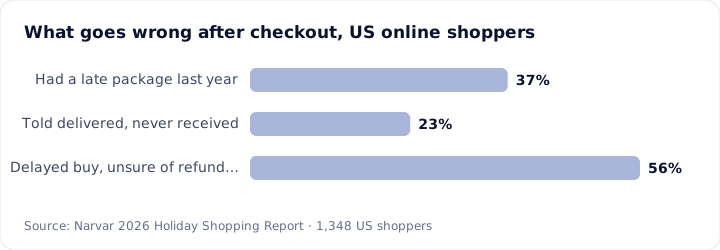
The problem is not rare. In the Narvar survey, 37% of 1,348 US shoppers had a late package in the past year, 23% were told a parcel was delivered when it never arrived, and 56% had delayed or avoided a purchase because they were unsure how long a refund would take [1].
Here is how a good call runs.
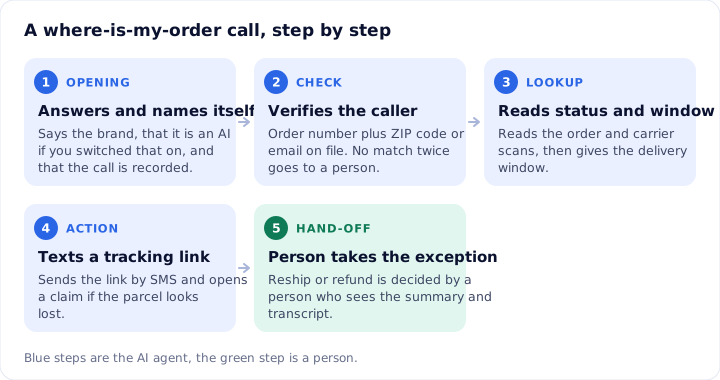
- The agent names your brand and says the call is recorded. VoiceGenie does not announce itself as an AI by default. That is a setting you switch on per agent, and I would switch it on. The recording notice is written into the opening line.
- It checks the caller with an order number plus the ZIP code or email on file. Two failed checks go to a person.
- It reads the status and delivery window from the order and carrier data.
- It texts a tracking link and, if the parcel looks lost, opens a claim.
- A person decides reship or refund, and sees a summary, the transcript, the caller's mood and what the AI already did.
Two warnings. An agent that cannot read live carrier data will guess, so fix the feed before the voice. And write your wording for split shipments and carrier delays in advance, because those are the questions that fill the queue.
Returns, order changes and cash-on-delivery confirmation
Returns are large. The NRF and Happy Returns forecast US retail returns of $849.9 billion in 2025, 15.8% of sales and 19.3% of online sales [4]. No public study I found splits ecommerce calls by reason, so do not trust any "70% of calls are WISMO" claim. Tag your own calls for two weeks.
| Call | Who owns it | Guardrail |
|---|---|---|
| Start a return inside the window | AI | Check window and condition, send the label, update the return |
| Exchange for another size | AI | Confirm stock before promising |
| Change address or size before the label prints | AI after verification | Text proof of the change. After the label prints, hand to a person |
| Cancel before shipping | AI after verification | Only while the order is unfulfilled |
| Return on day 45 from a loyal buyer | Person | The exception is a judgment about money and the customer |
| Chargeback notice, overheated product | Person | Legal and safety exposure |
Cash-on-delivery and order confirmation
A confirmation call reads the order back: item, price, address, delivery slot. It asks one question. Hear how that sounds.
Hello, this is Shop Easy. Your order is packed and ready to ship, and we have a delivery slot tomorrow between ten and twelve. Does that work for you, or would you prefer a different time?
In English: Hello, this is Shop Easy. Your order is packed and ready to ship, and we have a delivery slot tomorrow between ten and twelve. Does that work for you, or would you prefer a different time?
I found no public source for how many COD orders a confirmation call saves, so I give no number. Be careful about the opposite risk too. In a March 2020 survey of just over 1,000 US online shoppers, 64% said they probably would not proceed if asked to call customer service to confirm their order [13]. Confirm by call only where fraud loss is real, and prefer a text for everyone else.
Failed payments and abandoned carts
For a failed payment, the AI explains that the charge did not go through and texts a secure pay link. It never asks the caller to say a card number. PCI Security Standards Council guidance says to keep security codes out of the phone environment and make them unrecoverable after authorization, including in recordings [10]. If digits are spoken anyway, the recording and transcript come into scope.
Abandoned carts are a different kind of call. Baymard puts average cart abandonment at 70.22% across 50 studies, but 42% of US shoppers who left said they were just browsing, and the top stated reason for the rest was extra charges, at 40% [5]. A call fixes none of those. It helps with a question left unanswered, such as delivery date or return window. See our abandoned cart recovery use case for how the outbound call is set up.
Because it is a marketing call, consent is stricter, as covered below. For follow-up design beyond carts, read automating follow-ups with a voice assistant.
Peak season: overflow, not replacement
Do not point the whole queue at the AI before Black Friday. Use the AI as overflow. Your main number rings your team first. After four rings, when all agents are busy, or after hours, your phone system forwards to a VoiceGenie number. You bring your own carrier and numbers, so it sits behind your existing setup. Other requests become a callback ticket with a summary.
Timing matters more than technology. Pilot one call type well before the peak, or wait until after. A peak week is for a proven setup, not a first launch.
Pre-write the peak answers: carrier delays, split shipments, backorders, holiday return windows. Subscriptions need the same care. Recharge reports that about 61% of voluntary subscription cancellations happen at the first two renewals [12]. Let the AI offer skip or pause once, then process a clear cancel in the same call. Billing disputes and save offers go to a person.
What a person keeps
Sort every call by what a wrong answer costs. If it costs a repeat call, let the AI finish it. If it costs money outside your rules, let the AI collect the facts and a person decide. If the caller is upset, go straight to a person.
The AI keeps lookups, rule-based actions and policy questions. People keep:
- Refunds, replacements and credits over the limit you set.
- Damaged, wrong or missing items, because a person spots repeat claimants.
- Fraud holds, chargebacks and anything with a safety angle.
- Anyone who asks for a person. In a Gartner survey of 3,566 customers fielded in February and March 2026, 87% said it is essential that companies using GenAI offer a way to reach a human agent [11].
The hand-off must carry context, or the customer repeats the story and you lose the benefit. For hand-off measures, see how to measure the success of an AI voice bot.
The rules to get right (US)
This is general information gathered from public sources. Verify each rule on the official source before you rely on it.
| Rule | What it means for an ecommerce call |
|---|---|
| TCPA and the FCC's 2024 ruling | AI-generated voices are artificial voices. Calls need prior express consent, and advertising calls need prior express written consent [7][8] |
| Calling hours | Telemarketing is limited to 8 am to 9 pm in the called party's time zone [8] |
| Opt-outs | Stop requests must be honored within 10 business days [8]. FCC revocation rules take effect 25 Nov 2026 and let callers designate opt-out methods; the FCC is taking comment on shortening the 10 days [9] |
| FTC Mail, Internet or Telephone Order Rule | If you promise no date, you need a reasonable basis to ship in 30 days. If late, send a delay notice with a cancel option and refund in 7 working days, or one billing cycle on your own credit. The FTC lists penalties up to $53,088 per violation, adjusted yearly for inflation [6] |
| PCI DSS guidance | Keep card data off the call [10] |
On VoiceGenie, quiet hours, retry limits and do-not-call suppression can be set, and you can remove a contact from a dialing sequence by API. Subscription cancellation rules are unsettled at the federal level, so check current state and FTC rules.
Measure it, price it, and know when to skip it
Measure resolved orders and repeat contact within 7 days, not containment. Containment counts a caller who gave up as a win. Compare each number to your own two-week baseline. A 3-minute order-status call is 3 minutes at $0.14 per minute, billed per second, plus your carrier's charges. Try your own volumes.
A worked example. Move the sliders to match yours.
AI at $0.14 a minute with volume credit applied, plus Insights seats for the people who take handed-over calls. Phone line charges are your carrier's and are not included. Illustration, not a quote. Open the full calculator
Skip or delay voice AI when:
- Your order and carrier data cannot be read live.
- Most of your calls are damage claims and disputes, so there is little to automate.
- Nobody has approved the consent, recording and opening wording.
- You want the AI to grant refunds by judgment.
On fit: VoiceGenie covers AI calls and a human desk on one record. AI agents are usage based and human agents are a per-seat license. Setup is self-serve, or a managed service where VoiceGenie's team sets up and maintains agents. Customers cannot bring their own AI model. Storefront and carrier systems connect through the open API, webhooks or Zapier, not native connectors. VoiceGenie's security program is built to the SOC 2 Type 2, ISO 27001 and ISO 42001 standards, and it handles personal data in line with GDPR. Security documentation is shared on request. If you only need an IVR menu, compare in conversational voice AI vs IVR. Prices are on the pricing page.
Common questions
Can voice AI handle where-is-my-order calls?
Yes, when it can read your order system and carrier tracking. It checks an order number plus ZIP code or email, reads the status and delivery window, and texts a tracking link. If tracking shows a lost parcel or a delivered-but-missing package, it opens the claim and hands the call to a person with the details.
How much does a voice AI agent cost for an online store?
AI agents on VoiceGenie are usage based: $0.14 per minute, billed per second, with no minimum commitment. You bring your own carrier and numbers, so the phone line is billed by your carrier. A 3-minute order-status call is about 3 minutes of AI time. Human agent seats are a separate per-seat license.
Can an AI voice agent take card payments?
It should not hear card numbers. PCI Security Standards Council guidance says to keep security codes out of the phone environment and unrecoverable after authorization, even in recordings. Send a payment link by SMS instead, so digits never reach the AI, the transcript or the recording. Ask any vendor to demonstrate that flow before you sign.
Do I need consent for AI calls about an order?
In the US, yes. The FCC ruled in 2024 that AI-generated voices are artificial voices under the TCPA [7]. Order-service calls need prior express consent. Marketing calls, such as cart recovery, need prior express written consent. Capture consent at checkout, keep the record, and honor stop requests said in plain speech.
How do we cover Black Friday and holiday peaks?
Use the AI as overflow, so calls are answered on the first ring while your team works exceptions. Launch and test it well before the peak, not during it. Narvar found 37% of US shoppers had a late package last year, so expect tracking and delay calls, and pre-write answers for carrier delays and split shipments.
Sources
- Narvar, 2026 Holiday Shopping Report (1,348 US shoppers)
- First Orion, After The Sale Ends: 2022 Retail Industry Survey Report
- ContactBabel, US Contact Center Decision-Makers' Guide, 17th edition, 2025
- NRF and Happy Returns, returns expected to cost retailers nearly $850B in 2025 (via SDC Executive)
- Baymard Institute, Average documented online shopping cart abandonment rate, 2026
- FTC, Business Guide to the Mail, Internet or Telephone Order Merchandise Rule
- Cooley LLP, FCC: AI-generated robocalls are illegal under the TCPA (on FCC Declaratory Ruling 24-17), 2024
- 47 CFR 64.1200, Delivery restrictions (Cornell LII)
- Brownstein Hyatt Farber Schreck, New TCPA Revocation of Consent Rules Take Effect on November 25, 2026
- PCI Security Standards Council, Protecting Telephone-Based Payment Card Data v3.0, 2018
- Gartner, 87% of customers say companies using GenAI for customer service must provide access to a human agent, 2026
- Recharge, Subscription churn is front-loaded, 2026
- Digital Commerce 360, 33% of US consumers drop retailers after a false decline (Sapio Research for ClearSale, fielded March 2020), 2020
About this post. The rules, prices and figures here were gathered from public sources and were correct to the best of our knowledge on the date shown. They change, and they differ by country and state. This is general information, not legal or financial advice. Before you act, check the latest position with the regulator or company concerned, using the links above. If you spot an error, write to support@voicegenie.ai.
Founder and Chief Revenue Officer of VoiceGenie. Writes about how sales and customer teams put AI calling to work.
More posts by Maaz Ansari